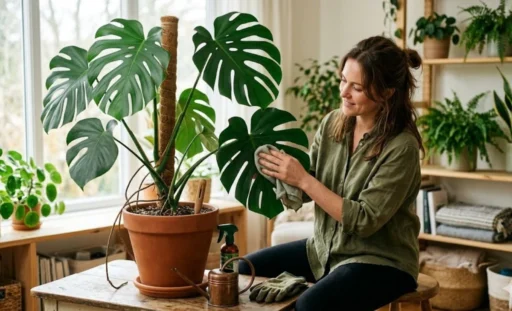
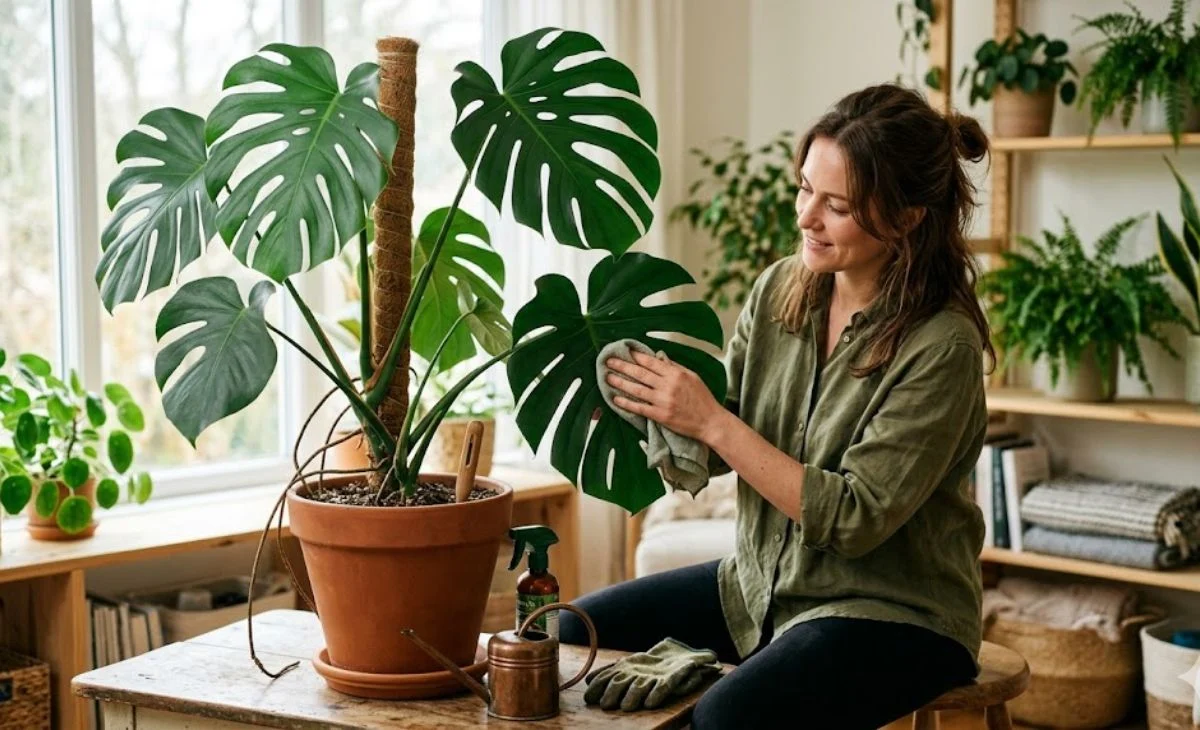
Enter any stylishly designed living room today, and there is a high likelihood of finding one plant standing out in the room without much effort on your part. The monstera deliciosa plant is one such plant with its large bright green leaves full of characteristic holes and splits that is among the easiest houseplants to recognize. Native to the tropical rainforest areas in South Mexico and Central America, the plant climbs up to towering heights, forming a canopy that covers the ground level with its leaves. However, more impressive still is the fact that despite its exoticism, this is a very easy to grow plant that can be rewarding for those who have them at home.
Is Monstera Deliciosa Easy to Care For?
Indeed, the monstera deliciosa can be seen as one of the easier tropical house plants to take care of since it is relatively forgiving when it comes to various aspects of keeping it. What it needs is an optimal combination of lighting, watering, spacing, and knowledge of how this plant grows naturally. Having all these factors covered, one can expect the monstera to flourish and reward the grower for his efforts by showing some impressive development.
This plant is part of the Araceae family and is quite similar to both the pothos and the philodendron. Some of its alternative names are Swiss cheese plant, hurricane plant, and fruit salad plant due to the tropical fruit that it bears in the wild, having a flavor of pineapple, banana, and mango combined.
Light Requirements for Monstera
The ideal location for keeping a Monstera is in the place receiving bright indirect lighting. In case of talking about speedy growth, huge leaves production, and characteristic split leaves, that would certainly be the main factor here. The place near a north-facing or east-facing window will be ideal in this respect. Moreover, positioning of the plant at some distance away from a southern/western-facing window when the sunrays won’t touch the plant will be also sufficient.
Too many hours of direct sunlight received in the afternoon period, particularly in hot days of summer, will simply burn the surface of the big leaves, causing the browning and crisping tips. On the other hand, insufficient light will cause slow-growing tiny leaves without fenestration. In case your Monstera plant has been growing and producing non-split leaves for quite a while, then not enough light would definitely be the first reason for consideration.
Watering Your Monstera Plant: Getting the Balance Right
Monstera is also often overwatered, and that is the most frequent error in caring for monsteras. The reason behind that is people consider this plant as some exotic tropic one, which has large leaves requiring lots of water and moisture, while it is not at all so. Actually, monstera deliciosa prefers rather to dry up a little bit than be too soaked in water and die because of rotting roots.
However, there is always one simple way of finding out how much watering your monstera needs. It requires you to feel it with your finger – when the upper two inches of the soil are still wet, you should not water your plant. When watering it, though, make sure you do it thoroughly enough, leaving the surplus to drain out and put it back where it belongs. In spring-summer season, do it every 7-10 days; in autumn-winter time, once in two or three weeks.
Some other watering pointers which matter much more:
- Room temperature is ideal for your watering since tropical roots will be shocked by cold water
- Avoid leaving the pot soaking in water, otherwise, the roots will become too soggy
- Make sure to water the plant at the base to prevent water contact with the stems and crown
- The appearance of yellow leaves is a clear sign of overwatering
Soil and Potting Mix
The monstera grows best in a rich, yet well-draining substrate. In most cases, a good quality potting soil is enough; however, many plant enthusiasts like to add other substances to increase drainage and air circulation. The blend of half potting soil and half perlite or orchid bark proves to be extremely efficient for a healthy growth of the plant, imitating the drainage capacity of the forest floor of its natural environment.
Never use soil mixes that hold excess amounts of water and are too dense. If the water pools on top of the soil layer instead of draining quickly from below, you need to change the potting mix immediately. The drainage system must always contain several holes at the bottom of the vessel because even the most experienced plant owners cannot rescue a monstera planted in such a pot.
Monstera Plant Care Guide: Temperature and Humidity
Ideal Temperature Range
For proper growth of Monstera deliciosa, the ideal temperature for the plant growth should be maintained at about 65 to 85 degrees F (18-29 degrees C). This temperature requirement is quite similar to that of household temperatures. The plant should not be exposed to cold currents, which can easily be done by not placing the plant in areas where windows are often opened or cooling devices. It should not be placed in heated zones since dry air will be encountered.
Humidity
Being a tropical plant, it’s safe to say that monstera require higher humidity conditions. For best results, humidity needs to be within the range of 60 to 80 percent, though the plant can do alright even in normal indoor humidity conditions from 40 to 50 percent. To ensure rapid growth, larger leaves and fenestration, increasing humidity helps tremendously.
Here are some ways to raise humidity for your monstera:
- Use a humidifier, which is the most reliable method.
- Cluster several houseplants together since they produce moisture.
- Use a saucer with pebbles and water where your plant will be kept but the plant pot won’t be placed directly inside the water.
- Spray the leaves with water occasionally, which is not as efficient but still might be used.
Fertilizing Monstera Deliciosa
If you need to grow monstera vigorously from spring to the beginning of autumn, it would be necessary to fertilize it. It is convenient to purchase a fertilizer having an equal percentage of nitrogen, phosphorus, and potassium (it is about 20-20-20). Moreover, one can purchase a liquid fertilizer meant for leafy plants. A fertilizer should be applied once a month using a very small amount (half of the recommended amount).
Winter fertilizing is not worth considering as plants slow down their growth considerably and absorb nutrients ineffectively, thus, accumulating salts in the soil. That is why rotting of roots proceeds very slowly. If there are white accumulations in the soil, you need to water your plant with a large amount of water until spring comes.
At Solera Gardens, we find that a simple, consistent feeding schedule in the growing season is all most monstera plants need to put out impressively large leaves throughout spring and summer.
Repotting: When and How to Move Up
It is possible for the plant to grow very fast when the right environmental factors are offered to it. It would help a lot to transplant your plant because it is going to grow very fast, and within no time, it is going to become a big plant. The signs that would show that your plant needs to be transplanted would be when roots come out from the drainage holes, when it becomes top-heavy, poor growth despite taking good care of it and roots growing from the topsoil.
The best time to transplant would be at the beginning of the growth season. It is recommended that you choose a new pot that is two to three inches bigger in diameter than the previous one. If this is done, it would result in excessive moisture retention, resulting in root rot.
As you remove the plant from the old pot, do so carefully while examining the roots at the same time. The healthy roots will have a white to light tanned color and will also feel firm. On the other hand, roots that are dark brown or black and also soft signify rotted roots that need to be removed using sterile scissors.
Supporting Your Monstera: Moss Poles and Climbing Structures
As for the forest, Monstera deliciosa climbs onto the trees to find appropriate spots with enough sunlight using aerial roots. Aerial roots are developed starting from the stem of the plant and have a cord-like shape that develops naturally over time. It is advisable to supply the indoor monstera with climbing aid since this will help to facilitate upward growth, allow development of large and fenestrated leaves, and no growth in other directions.
There are plenty of ways you can go about growing monsteras; however, one of the favorite ones is moss poles. The latter is capable of attracting the roots of the plants naturally and provides extra moisture to the roots. Moss poles may be substituted with such solutions as coco coir poles, wood trellises, and bamboo poles.
If you are thinking about expanding your indoor garden, the guide at What Do I Need to Start a Garden? covers the foundational tools, containers, and materials to help you get started on the right foot.
How to Propagate Monstera Deliciosa
One of the great advantages of growing monstera plants is the easy propagation once one learns how to go about it. There are several methods that one can use to propagate their monstera plants, but one of the best methods is by cutting a stem from the plant with a node. A node is a bump present on the stem of the monstera where the leaves grow from.
Here is how to do it step by step:
- Use sharp pruning shears or sterilize your knife to cut the plant, ensuring you cut just below the node and possibly even a small aerial root
- Prune off all the leaves from the bottom of the cutting except one or two on the top
- Put your cutting in a glass of water, making sure that the node is under the water, while the leaves are not submerged in water
- Put the glass in a sunny area, but out of the sun’s direct rays
- Replace the water after five to seven days, which keeps the roots oxygenated and fresh
- It will take around three to six weeks for the roots to appear; when they are two to three inches long, pot the cutting in damp soil
- Make sure the potted plant remains wet for the next few weeks
Spring and early summer are the best times to take cuttings, as warmer temperatures and longer days speed up rooting significantly.
Common Problems and How to Fix Them
Yellow Leaves
The yellowing of leaves is the most common problem of monsteras and usually indicates any of the following issues: overwatering, lack of light, and a nutritional deficiency. The easiest way to solve such a problem is to check how much water there is in the soil. If it is wet, then decrease the amount of waterings and make sure that the drainage is working correctly. If the soil is dry and there is insufficient light, relocate your plant closer to the windowsill.
Brown Leaf Tips and Edges
Dry brown tips usually signal low humidity and improper watering routine. Brown crispy edges that developed rapidly may also result from the direct sunlight exposure or the draft coming through the vents near your plant. To fix the problem, just change the place of your plant and raise its ambient humidity.
No Holes in the Leaves
It might be quite confusing for new monstera owners if their plant does not develop fenestrations and grows leaves that look like regular leaves. Usually, this happens because the plant is either young enough to have holes (typically, monstera begin to develop fenestrations at the age of two to three years), or because of insufficient lighting.
Pests
Monstera may be prone to spider mites, mealy bugs, scale insects, and fungus gnats. One can tell when there are spider mites in a plant because they create fine webs on the underside of the leaves as well as spots on the leaves’ surface. Infestations that occur early should be tackled using insecticidal soap or neem oil. In case one notices small flies flying near the soil, then this could mean that there is fungus gnat in the plant, meaning that it is retaining moisture for too long.
Wiping off the leaves with a wet cloth every four to six weeks whether there are pests or not is important. This is because the leaves have a high surface area and hence tend to accumulate dust.
Monstera Deliciosa Plant Care Quick Reference
| Care Factor | Requirement |
| Light | Bright, indirect light; no direct sun |
| Watering | Every 7-10 days in growing season; allow top 2 inches to dry |
| Soil | Well-draining mix; potting soil with perlite or orchid bark |
| Temperature | 65-85°F (18-29°C); avoid below 50°F |
| Humidity | 60-80% ideal; tolerates 40-50% |
| Fertilizing | Monthly with balanced liquid fertilizer; spring through early fall only |
| Repotting | Every 1-2 years; pot up 2-3 inches in spring |
| Support | Moss pole or coco coir pole recommended as plant matures |
| Toxicity | Toxic to cats, dogs, and humans if ingested |
| Mature size indoors | 6-10 feet tall with leaves 12-18 inches across |
Is Monstera Toxic to Pets and Children?
It could be considered as one of the most significant aspects taking into account the question about whether you need this plant in your garden or not. Indeed, it seems clear that we should admit that this plant is extremely toxic for living organisms, including domestic animals starting with cats up to horses, dogs and even humans who decided to taste some part of this plant. All this is caused by some crystals of calcium oxalate which are not absorbable.
If somebody tasted this plant or drank its juice, it is necessary to call veterinarian or ASPCA Animal Poison Control Center whose phone number is 888-426-4435. It is highly recommended to prevent approaching this plant from animals and people, particularly children. Finally, I would like to say that you should keep in mind one aspect, namely that only ripened fruits are safe for humans.
The only one exception that should be highlighted is the ripe fruit that is consumable by humans when it matures fully. The process of maturation takes more than one year and leads to the development of a taste characterized as “tropical fruit salad.” Nonetheless, the ripe fruit continues being toxic for pets.
Frequently Asked Questions
Why does my monstera have no holes in its leaves?
Fenestrations occur on Monstera leaves when the plant gets matured enough to get sufficient light. The young Monsteras generally do not have any fenestrations in their leaves, but as they grow, they require bright indirect light for at least six hours each day for producing fenestrations in their leaves.
How fast does monstera deliciosa grow?
The growth rate of Monstera deliciosa is quite high when the growth conditions are perfect, and it produces one leaf within every four to six weeks during spring and summer. The growth slows down in autumn and winter seasons.
How often should I repot my monstera?
The majority of monsteras require repotting after every year or two. Roots coming out from drainage holes or stunted growth can indicate that your Monstera needs repotting. It should be done in spring in a larger pot than the current one.
Can monstera grow in water permanently?
It is possible to grow Monstera in water, but this approach is highly discouraged since the plants become unhealthy and are susceptible to root rot. The use of water should only be applied as a temporary measure while waiting for the plants to establish themselves in soil.
Is monstera deliciosa the same as split-leaf philodendron?
Absolutely not Monstera deliciosa and split leaf philodendrons are totally different types of plants even if they come from the same family.
Conclusion
The monstera deliciosa plant fully justifies all the attention that it receives. It adds real flair to a room in terms of tropical plants, grows rapidly once you have met its basic requirements, and displays increasingly large leaves as time passes. To take care of this plant, you must give it plenty of indirect sunlight, only water the plant once the first inch of the soil has dried out, make sure it gets fertilizer regularly, and provide something for it to climb. Take care of the above and it will repay you in terms of impressive leaves.
For anyone looking to build out a fuller, more diverse indoor or outdoor garden, the complete growing guide at How to Grow Lavender: Guide to Planting and Care is a great companion read for adding fragrant, low-maintenance beauty alongside your tropical foliage plants.
Before choosing a spot for a houseplant, use our indoor plant light guide to assess the available light.
If roots have outgrown their pot, follow our houseplant repotting guide for pot selection and aftercare.