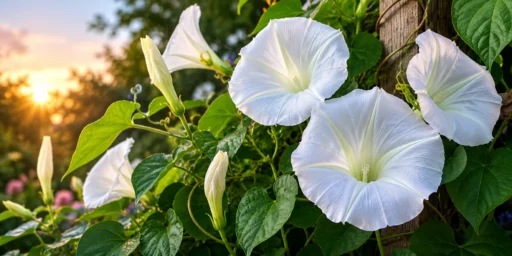
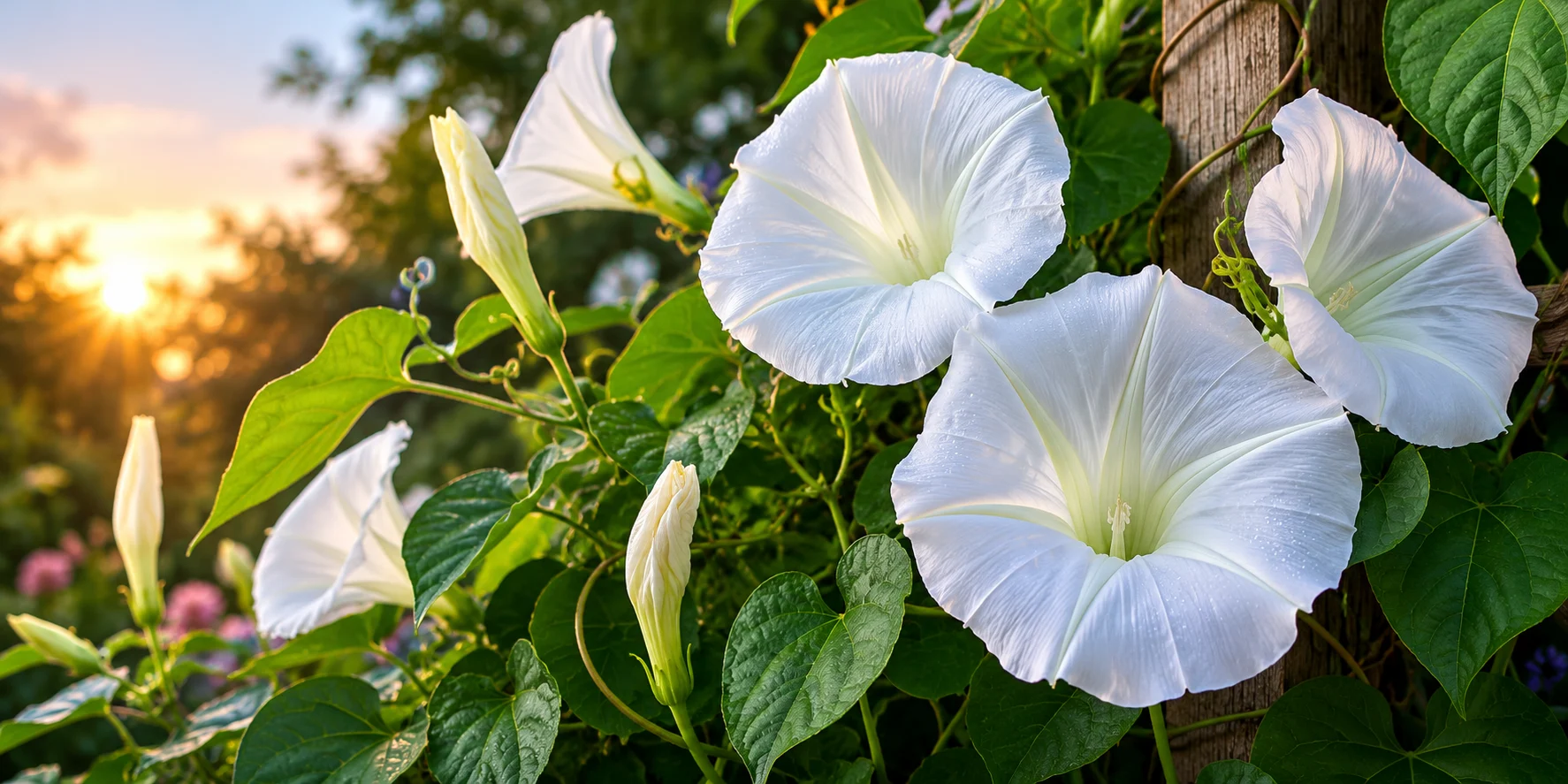
In case you would like to turn your evening setting into a fragrant garden of beautiful white flowers, How to Grow and Care for Moonflower is your golden key. For proper growth of these wonderful flowers, you need to place them under full sunlight, provide sturdy support from a trellis, and keep the soil moist but well-drained. Since they are tropical perennials used as annuals in colder climates, providing heat and enough water once they establish themselves will surely give you amazing results from mid-summer till the first frost of winter. Fulfilling all these simple conditions, you will be able to see big saucer-shaped flowers blooming before your eyes in the evening.
The rapidly growing plants come from the Convolvulaceae, the family of the morning glory plants. These plants are extremely valued due to their spectacular evening behavior. Contrary to the majority of garden flowers that display their beauty during the daytime hours, these amazing plants have their flowers tightly shut until sunset comes and only after it, the buds quickly open up and emit an extremely sweet scent, attracting large pollinating moths. Let us find out how to plant the plants in your garden.
How Do You Successfully Grow and Care for Moonflower?
In view of this, growing this fantastic climber becomes extremely easy considering its tropical habitat and its aggressiveness in terms of climbing. In order to get good results, one needs to plant the vine in an area where it can receive around six to eight hours of sunshine every day. Although the bloom occurs at night, it requires lots of sunshine during the day because the green leaves require enough energy from the sun to produce sufficient amounts of sugar required for thick buds.
It is a great idea to select plants that will bloom according to a certain schedule when creating a garden that spans from day to night. Our team of gardening consultants at Solera Gardens believes that there should be a mix of textures and heights to give your garden depth.
If you wish for the vine to grow quickly and be healthy, then you have to plant it in fertile soil that drains properly, as well as having a neutral pH level. Do not plant it in very fertile soil or over-fertilize it with nitrogen, since the result will be large green leaves with no flowers.
Understanding Moonflower Botany and Varieties
The botanical name of this wonderful plant is Ipomoea alba, though it may also be known by other names such as the moon vine or white morning glory. Originating from the tropical and subtropical areas of the American continents, this is a very delicate perennial in the USDA zones 10 through 12. This species is characterized by being a woody vine which climbs every year until it grows as tall as thirty feet in these warmer parts.
In cooler climates where it grows in USDA zones 9 and below, the plant is cultivated as an annual due to its frost-tender nature. The plant fulfills its complete life cycle in a year and dies back at the end of the growing period when the weather starts cooling down in autumn. Though it is an annual in cooler climates, it grows rapidly and covers up any trellis or fence in no time.
The beauty of the flowers makes the plant beautiful. The flowers measure from five to six inches across and are usually white. Additionally, the flowers have a pattern of lime green stars that come out from the center of the flower. The leaves of the plant are equally beautiful. The leaves are dark green with heart-shaped leaves.
Step-by-Step: How to Grow and Care For Moonflower
Learning How to Grow and Care For Moonflower is a rewarding journey that begins with proper seed preparation and timing. Because these plants are tropical natives, they require warm conditions to germinate and will not tolerate cold spring soil.
Preparing the Seeds
The seeds of this vine are large, hard, and light tan in color, featuring a tough outer shell that naturally resists water absorption. To speed up germination, you must nick the seed coat using a nail file or sandpaper to allow moisture to penetrate. After nicking, practice soaking moonflower seeds in warm water for twenty-four hours before planting to trigger rapid cellular growth.
Sowing and Germination
If you live in areas that experience cold weather, with less summer season, sow your seeds about four to six weeks before the last spring frost indoors. The best approach to follow is planting your seeds half-inch deep in individual biodegradable peat pots, in order to lessen stress on their roots during transplanting. Maintain the temperature of the growing area at 70-80 degrees Fahrenheit, and in seven to fourteen days’ time, you can expect to see some sprouted green plants.
Transplanting and Spacing
It is only after all chances of frost in the spring season have entirely disappeared and nighttime temperatures have reached fifty degrees Fahrenheit that you can start planting them outdoors. You need to plant them twelve to eighteen inches apart from one another at the foot of your chosen climbing support system. Remember to take care of their roots as these plants are very vulnerable to transplant shock.
TYPICAL SEED GERMINATION PROCESS
Hard Seed → Nick Seed Coat → Soak for 24 Hours → Sow ½ Inch Deep → Maintain Warmth (75°F / 24°C)
Designing a Sensory Twilight Landscape
It becomes very important for you to give careful consideration to the layout and companionship of these night blooming climbing plants in your back yard. As these flowers bloom and give out their fragrance in the evenings, therefore they can be used in your garden in those spots where you sit and enjoy your evening. They would give you the enjoyment of their pleasant aroma and shining white flowers under the light of the moon.
If you want to have a lively garden full of insects and colorful flowers from morning till evening then it becomes very important for you to use appropriate plants in your garden. If you pair these night bloomers with How to Grow and Care for Lantana that is suitable to hot weather, then your garden would have an excellent visual relay race.
Besides being visually appealing, the best nighttime gardens are built using very strong fragrances. Growing a plant such as How to Grow and Care for Rosemary which is a very hardy kitchen plant will add a great aroma to your garden paths. You can enjoy the lovely herbal smell of this plant mixed with the wonderful fragrance of flowers. With this unique aromatic combination, each walk in your garden at night will be unforgettable.
The other technique is making a moon garden. It involves the use of flowers and silver foliaged plants such as dusty miller, lamb’s ear, and white petunias. These plants will give you a shining garden at night as silver and white surfaces will reflect light from the moon.
Quick Reference Guide for Moonflower Care
The table below outlines the essential environmental and cultural settings required to maintain a healthy and robust climbing vine.
| Care Factor | Optimal Requirement | Key Tips for Success |
| Light Exposure | Full sun (6 to 8+ hours daily) | Direct daytime sun is required for heavy evening blooming. |
| Soil Conditions | Moderately fertile, exceptionally well-draining | Tolerates poor soils; amend heavy clay with organic compost. |
| Soil pH | Slightly acidic to neutral (6.0 to 6.8) | Keep pH balanced to ensure smooth nutrient absorption. |
| Watering | Consistent moisture; deep and infrequent | Water when the top inch of soil feels dry; avoid soggy roots. |
| Hardiness | USDA Zones 10 to 12 (Perennial) | Treat as a warm-season annual in cooler northern climates. |
| Fertilizer | Low nitrogen, high phosphorus | Use bone meal to encourage blossoms instead of excess leaves. |
Installing Sturdy Climbing Supports
This vigorous Night blooming vine needs a strong structure as it grows because the mature plant becomes very heavy due to the numerous branches it grows. Towards late summer, a matured plant has numerous branches laden with thick foliage and flower buds that make the plant very heavy. Without proper support, the plant will just lie on the ground where it is prone to all sorts of problems.
- Trellises and Lattices: The ideal surface for the plant to grow on will be a wooden or metal trellis mounted against the wall or the fence.
- Arbors and Pergolas: The plant will create a lovely canopy around the entrance of the patio or the pergola.
- Heavy-Gauge Wire: Vines can easily be made to climb on vertical wires set up on posts or columns.
- Soft Plant Ties: Do not use thin plastic or wire as these may harm the growing stems.
In the beginning, when the vine starts growing, it is advisable to guide its main shoots towards the climbing framework. The moment the plant touches the framework, its shoots will automatically wind around the framework with little effort. This can be done through regular observations during early summer.
Essential Maintenance and Pruning Habits
Although these plants do not require much maintenance after being planted, there are certain grooming tips that will help to keep your plants neat and full of flowers. They grow very quickly in hot climate, therefore, a little bit of direction is quite helpful to keep your plants well-balanced.
Pinching Young Shoots
At the height of about twelve inches, pinch the top growing tip with your fingernails. In doing so, you make the plant grow bushier and give more flowering stems. Otherwise, they will continue to grow only one stem, which will be long and leggy, with less buds on it.
Deadheading and Seed Prevention
The other important thing is the timely removal of old flower heads to prevent the formation of seed pods. It is especially useful for the climates that are warm enough for this plant to become a perennial because deadheading will allow you to redirect all the energy to the production of flower buds instead of the seeds.
Mid-Season Clean Up
During the whole summer, check the vine from time to time and take off any yellow or crossed leaves to facilitate ventilation. Ventilation between the thick green foliage is necessary in order to avoid any fungus problems. In case your vine starts getting into the way, just trim it gently.
Diagnostic Guide for Common Cultivation Issues
Though these plants are very resilient, they sometimes suffer from some problems due to improper watering or nourishment of the plants. With these signs, one will know the problem he is having and will know how to deal with it so that his plant remains perfectly healthy.
The Mystery of No Blooms
In case your vine is growing rapidly and developing healthy and green leaves but is not developing any flowers, then it might mean that you have used too much nitrogen in your plant. High-nitrogen fertilizers or rich soil forces the plant to grow only in the vegetative state. The solution to this problem is by stopping nitrogen feeding and using phosphorus fertilizers like bone meal.
Powdery Mildew and Fungal Spot
Fungus appears like white or brown dust on the leaves and grows mostly in humid conditions where the temperature is relatively high. In order to prevent the development of fungus in the plant, you should not water the plants from above since fungi mostly develop on moist leaves. Water your plant directly onto the soil and give your plants enough space so that the wind dries them.
Sap-Sucking Pests
Although the strong smell and the sticky juice deter any pests from attacking it, at times, you can come across spider mites, white flies, and aphids under the leaves. However, a strong water pressure from your garden hose should do the trick for removing the pests from the stems. In case of continuous attacks by the pests, use insecticidal soap or neem oil.
Frequently Asked Questions
Can moonflowers grow in pots?
Indeed, it is very easy to grow such plants in huge pots in sunny patios or balconies. It is important to ensure that the pots used to grow such plants are durable and have the capacity to hold at least five gallons of soil as well as having drainage systems. It is also important to ensure the erection of trellis in the pots or nearby the railing in order to ensure support for the climbing stems.
Are moonflower plants toxic to dogs and cats?
It is clear that all parts of such plants including their huge seeds are toxic and therefore poisonous both to animals and human beings. The seeds are hallucinogenic and can lead to irritation of the stomach, confusion and dilation of the pupil. Such plants should be grown far away from the reach of domestic animals, livestock and children.
Why is my moonflower vine not blooming?
There are two major causes of non-blooming of plants, first there is excess nitrogen in the soil while the other one is inadequate light during the day. Shadows are not conducive for such plants to get sufficient sun energy to blossom during the night time.
Do moonflowers open every night?
Certainly, after maturing in midsummer, the plant will continue to flower every single night until the arrival of the cold autumn days. Every flower blooms only once; it opens in the evening and remains open throughout the night, and then withers away in the heat of the following morning’s sun. A healthy vine bears many flowers so that there is a constant nightly bloom.
Do you have to soak moonflower seeds before planting?
Although not absolutely necessary, it is strongly recommended that you soak the seeds since this process greatly boosts your chances of successful germination. Since the outer cover of the seeds is meant to keep the embryo safe for long durations of time, their natural germination could take up to a few weeks.
Conclusion
In summary, How to Grow and Care For Moonflower is among the most fulfilling ventures that you could embark on to enhance your garden after dusk. Simply by giving the vigorous climber sufficient sunlight, a strong support and regular moisture, you will have created your own night garden. All that is required from you is simply to prepare your seeds and watch the levels of fertilizer applied; you will soon be graced with bright-white flowers and fragrances throughout the summer period.