A few tiny flies lift off when you water a plant, then another lands beside your coffee. Swatting the adults is understandable, but it leaves the source of the problem untouched.
To get rid of fungus gnats in houseplants, identify the flies, correct persistently wet potting conditions, monitor adults with yellow sticky traps, and use a treatment labeled for fungus gnat larvae if needed. Work on the growing medium as well as the insects you can see. Do not dry a moisture-loving plant to the point of damage.
This is a troubleshooting guide for ordinary home collections, not a greenhouse pesticide program. Start with the least disruptive steps and keep a short record so you can tell whether they are helping.
Make sure the flies are coming from your plants
Fungus gnats are small, dark, delicate flies with long legs and antennae. Their larvae look pale and wormlike, with a dark head. Adults often stay close to pots or gather at windows. University of California IPM describes this combination of appearance and behavior in its fungus gnat identification guide.
Finding a fly near a plant is not enough to identify it. Watch the pot before watering, then gently disturb the surface without damaging roots. Look for repeated activity at the growing medium. If insects mostly gather around ripening produce or food waste, investigate that area too.
North Carolina Cooperative Extension’s Beaufort County guide distinguishes fungus gnats, which favor moist growing media, from fruit flies associated with ripening fruit. You can have more than one small-fly problem at once, so avoid assuming every insect in the kitchen has the same source.
For an uncertain identification, photograph an insect on a trap beside a ruler and contact your local Extension office. Include where you found it. A sharp close-up and a location are more useful than a photograph of the whole room.
Are fungus gnats hurting the plant?
The adults do not bite people or chew houseplant leaves. Larvae can damage roots when abundant, with young plants and seedlings more vulnerable. However, UC IPM notes that poor watering, drainage problems, and root disease are more common reasons for wilting than fungus gnat injury.
Separate the two questions: “Why are there flies?” and “Why is this plant declining?” A pot can have both gnats and a watering problem. Finding the insects does not prove they caused every yellow leaf.
If the plant is wilting while the mix remains wet, pause before adding more water. Record the moisture condition and inspect drainage. A plant in rapid decline deserves prompt diagnosis rather than several weeks of changing traps alone.
Find the pots that are supporting the infestation
Check the collection pot by pot, including small cuttings tucked behind larger plants. North Carolina Extension identifies newly purchased plants, contaminated potting media, and openings into the home as possible entry routes. It also recommends drainage holes and avoiding retained water in saucers.
Give each suspect pot a simple label such as Kitchen A or Shelf B. Then record:
- The plant name, if known, and the location.
- Whether the actual planted container has drainage holes.
- Whether water is collecting inside a decorative outer pot.
- The date it was last watered and how the surface feels now.
- Whether fallen leaves or other decomposing material cover the mix.
- Whether adults repeatedly emerge from that particular container.
You are looking for a pattern, not a reason to blame yourself. For example, one nursery pot may be draining properly while a second is standing in water inside its cover. The two plants need different corrections even if they were watered together.
Adjust watering without putting the plant through drought
University of Wisconsin Extension recommends letting the top inch of the growing medium dry before watering as a fungus gnat management measure. Treat that as a starting point for compatible houseplants, not a universal rule for seedlings or species that need consistent moisture.
Replace the calendar question, “Is it watering day?” with a check of the plant and its mix. Feel the surface, assess moisture below it as appropriate, and compare the pot’s weight with how it feels after drainage. Do not rely on surface color alone.
For a practical test, keep your normal checking day but stop automatically watering every pot. Write “checked, still moist” when water is not needed. That small change makes it easier to notice a container that stays wet much longer than the others.
Colorado State University Extension explains why problems often become noticeable in fall and winter: reduced growth and water use can leave a familiar watering routine supplying too much moisture. Its guidance also identifies deteriorating growing media as a potential contributor.
If a plant recently moved into a dimmer position, use our indoor plant light guide to reassess the location. Do not put a shade-adapted plant into harsh sun simply to dry the pot faster.
Use sticky traps to measure progress
Place yellow sticky cards near affected plants, following their placement instructions. Wisconsin Extension recommends them for catching and monitoring adults, and specifically distinguishes them from vinegar traps used for fruit flies. Traps are useful evidence, but they do not remove the immature insects already in the potting medium.
Date each card and keep its position consistent. Photograph it at comparable intervals before replacing it. Comparing a fresh card with one that has been collecting insects for a month tells you very little.
A manageable record might read: “Shelf B, new card Monday, photograph Thursday, replace next Monday.” Use the same observation period each time. If the card becomes too crowded to read, replace it sooner and note the shorter interval.
Position traps where children and pets cannot touch them and where leaves will not stick to the adhesive. Keep the comparison simple enough that you will actually continue it.
When a larval treatment is worth considering
If the source pots are identified and the moisture corrections are in place but the problem continues, consider a product specifically labeled for fungus gnats in your type of indoor planting.
Wisconsin Extension describes Bacillus thuringiensis subsp. israelensis, usually shortened to Bti, as a biological treatment for larvae. It does not control eggs, pupae, or adults. That stage-specific action is one reason a single treatment may not end all visible activity.
UC IPM notes that the Bt used against caterpillars is different from Bti. Do not substitute products merely because both names include “Bt.” Use the current package directions for preparation, application, and any repeat interval rather than a generic internet recipe.
Choose one suitable approach and record it clearly. Adding several products at once makes it difficult to evaluate the result and can create avoidable handling complications.
Read the label before treating an indoor pot
The EPA’s “Do’s and Don’ts of Pest Control” advises using products only where their labels permit, following safety warnings, and never assuming a stronger dose is better. It also warns against using outdoor chemicals indoors and transferring pesticides into food or drink containers.
Before opening a product, find these details on its label:
- The pest it targets.
- The permitted location and plants.
- The application method and amount.
- Any repeat-treatment instructions.
- Protective equipment, access restrictions, storage, and disposal directions.
If you cannot match the label to your situation, stop and get product-specific advice. A social-media recommendation is not a substitute for those directions.
Should you replace the potting mix?
Repotting is not the automatic first step when you see two flies. Consider it when the growing medium has deteriorated, drainage is unsuitable, or an assessment reveals a root-zone problem. Colorado State Extension includes replacing broken-down, excessively moisture-retentive media among its management options.
Our houseplant repotting guide covers root inspection, pot selection, and aftercare. If repotting is justified, prepare the fresh mix and container before taking the plant apart. Do not move it into a much larger pot just because you are already doing the work.
Photograph the roots and old mix during the process. Keep the new mix’s label. If the problem returns, those records will help you distinguish a continuing moisture issue from a new introduction.
Troubleshooting when the gnats keep returning
| What you notice | What to investigate | Useful next step |
|---|---|---|
| One pot has far more trap activity | A local moisture or drainage problem | Compare that container with the quieter pots |
| Adults remain after a larval treatment | Whether treatment targets the stage currently visible | Review the label and continue consistent monitoring |
| The surface seems dry but the plant is wilting | Conditions deeper in the pot and root health | Assess the plant rather than watering by appearance alone |
| Flies persist away from all plants | Identification or an overlooked source | Collect a clear photograph and seek diagnostic help |
Use the table to decide what evidence is missing. Avoid changing the treatment simply because one adult appeared on a window. Compare the overall pattern and the condition of the plants.
Frequently asked questions
How long does control take?
Think in weeks rather than overnight. Colorado State Extension describes an egg-to-adult life cycle of roughly three to four weeks at typical room temperatures. Your outcome depends on the conditions and whether the breeding source has been addressed; this is not a promised clearance date.
Will vinegar traps solve it?
They are not the monitoring method Wisconsin Extension recommends for fungus gnats. Confirm the insect and use yellow sticky cards around the relevant pots instead of assuming a fruit-fly method will transfer.
Do I need to throw every plant away?
No. Begin with identification and a pot-by-pot assessment. Make decisions about an individual struggling plant from its condition, not from the presence of a fly somewhere in the room.
What should I do today?
Identify the busiest pot, inspect its drainage, and start one dated trap record. Check moisture before the next watering. Those observations give you a useful starting point without repotting an entire collection or buying several treatments at once.
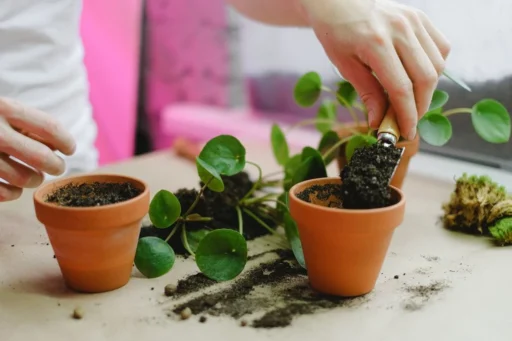
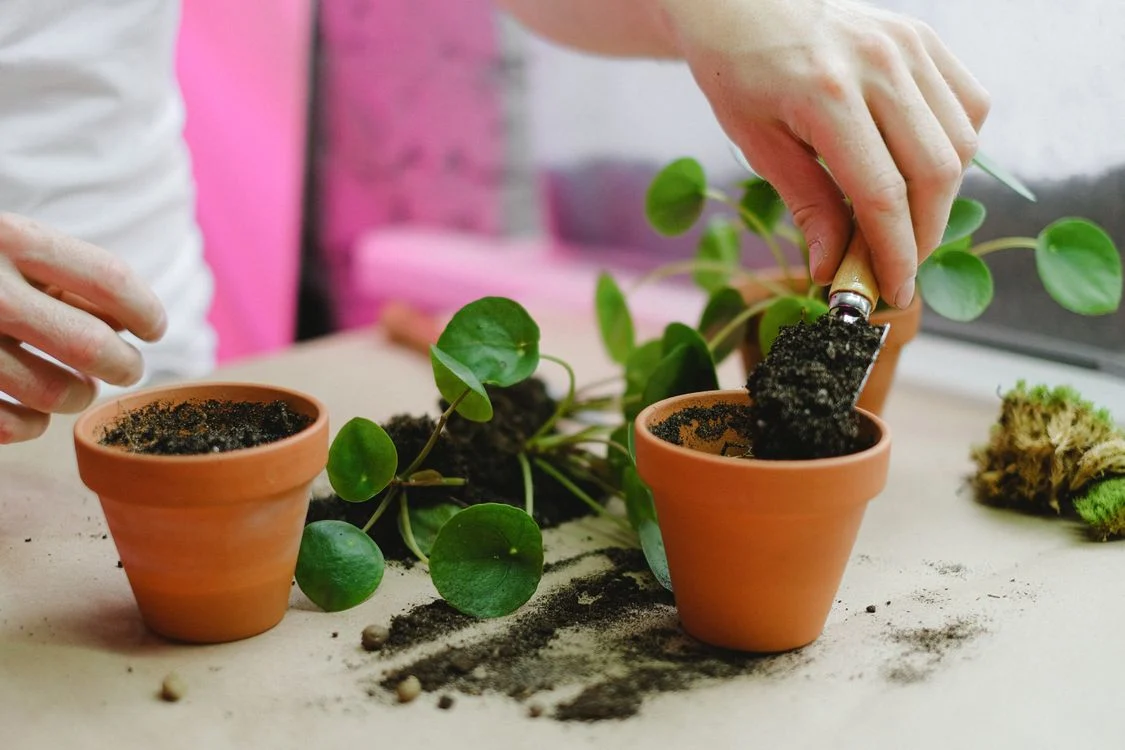
Featured photograph: houseplant repotting, Anna Shvets / Pexels. The image illustrates container care, not a diagnosed infestation.