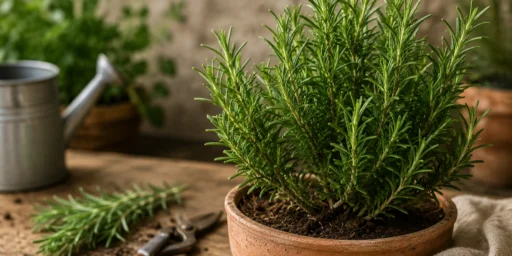
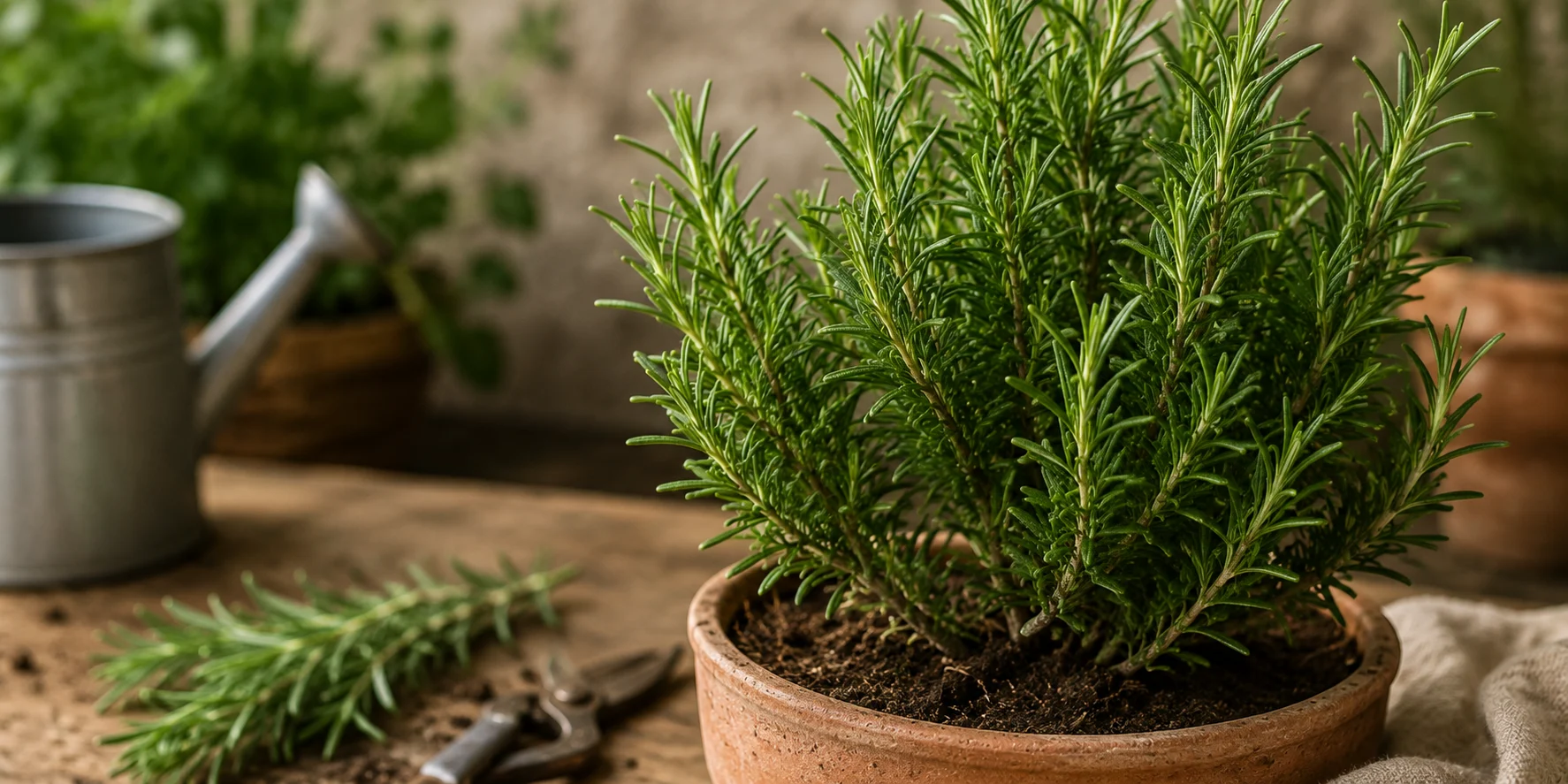
If you want to enjoy fresh, aromatic herbs right outside your kitchen door, learning how to grow and care for rosemary is the perfect place to start. This shrub is very versatile, as it gives gardeners a great variety of herbs for cooking and is perfect for growing drought-resistant plants. Once you gain experience in terms of how to grow rosemary effectively with enough sunlight, proper drainage, and water supply, it will be no problem to grow this magnificent plant at all.
Rosemary shrubs are distinguished by special needles, fragrance of the leaves, and beautiful blue flowers, which blossom in late spring as pollinator magnets. Whether you want to grow rosemary in your garden or raise this herb in a nice-looking pot on your patio, all the information on how to take care of this wonderful plant is given below.
How Do You Successfully Grow and Care for Rosemary?
In case one chooses rosemary cultivation, then the only possible thing that should be done to have success with it is to create conditions similar to those found in its natural habitat – Mediterranean climate zone. In fact, rosemary needs a lot of sunshine, properly drained soil and continuous care to avoid excess water around its roots. Yet, when rosemary is cultivated, maintenance is not necessary.
Since it shares the same sun-loving, drought-resistant qualities, learning How to Grow Lavender: Guide to Planting and Care can aid in developing an aesthetic, aromatic flower bed. These two traditional woody herbs grow well under the same environmental circumstances and look great when planted together. Offering your plants an environment that is warm and windy will aid in their successful development during the growth period.
This knowledge of how it grows will certainly help you take care of it for an extended period of time. When not pruned, it may end up being fairly woody and leggy at the base. Therefore, some shaping is recommended. This knowledge about the general culture of the plant will surely help you avoid the typical mistakes that many novice herb gardeners make.
Understanding Rosemary (Salvia rosmarinus)
Scientifically called Rosemary (Salvia rosmarinus), though for many years, it was scientifically referred to as Rosmarinus officinalis, this plant is a member of the mint family, Lamiaceae, and as such, the reason for the aromatic nature of the leaves as well as the square stem at the beginning of its growth stage. Being native to the Mediterranean region, this plant grows as a hardy and long-lived shrub.
Being useful due to the presence of essential oils in the pine-like long and narrow needles, these oils not only give the plant its unique aroma and taste, but also make it stable both during the process of cooking as well as baking. The leaves of the plant are dark greyish green in color on the top while white silky hairs cover their underparts.
Depending on the climatic conditions prevailing in your area, the plant may grow either as an outdoor evergreen shrub or potted herb depending on the climatic conditions of your environment. In case there are relatively warm winters without any freezing temperatures in your area, it will grow as an evergreen all through the year.
Exploring the Main Types of Rosemary
To start with, it needs to be said that there are different species of this plant, which can be applied in landscape design in different ways. They can be classified into two categories depending on their shapes, including the upright and the creeping/prostrate ones.
Upright Varieties
As far as the upright varieties are concerned, one can say that they form strong upright shrubs and function as excellent aromatic hedge or border plants in the garden. For example, such a variety as “Arp” of this plant is recognized as one of the most frost resistant varieties among others. Speaking about the variety “Tuscan Blue”, it is characterized by rich dark green leaves and blue-purple flowers.
Creeping and Prostrate Varieties
The creeping/prostrate varieties form horizontally and work as perfect cascade plants on walls, baskets, and edges of the large stone planters. Such varieties as “Prostratus” and “Irene” are great evergreen ground covers for sunny dry spots where no grass can grow at all.
Essential Rosemary Plant Care Requirements
The right cultivation of rosemary is by striking the balance of three basic elements; the light, earth, and water that will mimic the conditions of the Mediterranean coast. The balanced elements will give you a fast-growing plant and aromatic leaves. Now that you have an idea of the balanced elements, let us examine the other requirements of the rosemary.
Sunlight and Location
The first requirement of the rosemary plant is that it needs a sunny spot as this is the place where the plant grows and develops its aromatic oils. It should get at least six to eight hours of sunshine per day; otherwise, the plant will have poor stems and lack the fragrance.
Soil Preferences and pH
For such plants, the best type of soil should have good drainage capabilities. It should be either light, sandy, or gravelly soil, having exceptional draining capacity. Heavy clay soils prove to be extremely harmful as they retain moisture around the roots of the plant. For those of us cultivating beautiful spaces at Solera Gardens, The creation of the perfect soil base is always the primary concern. For such plants, the soil should have a pH between 6.0 and 7.5.
Watering Frequency
Since this plant performs well in soil with very low levels of water, it needs all of its soil to be fully dry before every irrigation. Usually, an irrigation period of 1-2 weeks should be enough but it depends on the weather in your area and type of soil. During watering of your soil, make sure that your soil gets fully soaked in water and afterwards, drain it completely.
Temperature and Humidity
Matured plants can survive winters that are fairly cold to -10 degrees Fahrenheit in the soils that are well-drained. High levels of humidity can be challenging for this plant since they prevent air from moving around the leaves that contain oils. In case your area experiences humid weather, then it is advisable to grow the plant sparsely such that it dries by itself due to the wind.
How to Plant Rosemary for Success
By knowing how to plant rosemary, you can avoid the shock of the young plants and have a healthy growth process for the herb. Since this plant is not able to survive in water logged areas, your planting method must involve good drainage.
Planting in the Ground
For example, if you are planting in the garden bed, make sure that you dig a hole twice as large as the root ball and as deep as the root ball. In case the soil in the garden is not loose, then make sure that you add some sand or agricultural grit in the backfill soil. You are supposed to maintain the spacing between the starter plants to about two to three feet in order to allow for their growth to its fullest capacity.
Container Gardening
Growing the plant in pots is another of the most effective methods, especially during the winter seasons, where there is frost in the region. Make sure that you select either the clay or the terracotta pot of at least 12 inches in diameter and depth, with appropriate drainage holes. The potting soil should be prepared using light soil made of perlite or poultry grit.
This way, you can easily relocate the plant from one place to another, in case of bad weather conditions such as wet or cold weather. Terracotta pots are recommended because of the porosity of their walls which drains the extra water.
Quick Reference Guide for Rosemary Care
The table below summarizes the critical care specifications required to maintain a healthy, productive herb plant.
| Care Factor | Optimal Requirement | Key Tips for Success |
| Light Exposure | Full Sun (6-8 hours daily) | Place near south-facing walls or open garden beds. |
| Soil Type | Sandy, gravelly, well-draining | Mix in grit or perlite; avoid heavy, wet clay. |
| Soil pH | 6.0 to 7.5 (Neutral to Alkaline) | Add garden lime if your soil is highly acidic. |
| Watering | Dry out thoroughly between waterings | Water deeply, then let the top three inches dry out. |
| Hardiness | USDA Zones 7-10 | Bring potted plants indoors in colder zones. |
| Fertilizer | Minimal to none | Apply a light compost layer in early spring. |
Propagating Rosemary Successfully
Although purchasing starter plants is very convenient, growing your own rosemary is an extremely satisfying and economical endeavor. You will be able to increase your garden variety or give herbs to your friends or neighbors. Let us look at the two most common ways of doing that.
Growing from Cuttings
The most appropriate method of propagating this plant is using stem cuttings. In order to propagate, take a cutting that is around three to four inches long from the healthy and flexible young growth of a mature plant in late spring. The leaves at the first two inches of the stem should be stripped off and then the stem should be planted in a small pot filled with moist perlite. Put the pot in a warm place and the plant will grow in three to six weeks.
Growing from Seeds
This plant can be propagated using seeds; however, it takes quite a lot of time because the plant grows rather slowly from seeds. The germination rate for this plant is quite low and it equals fifteen percent. Thus, in case if one wishes to grow the plant from seeds, it should be started indoors ten weeks prior to the last frost in spring.
Pruning and Harvesting Your Rosemary Bush
Maintaining the plant is required in order to keep it attractive, bushy and productive for a long period of time. Proper harvesting technique helps to ensure that the plant continues producing yummy shoots through the whole warm season. Below there is some information about harvesting and pruning of the plant.
Pruning to Prevent Legginess
Rosemary should be pruned once in a year immediately after flowering either in the late spring or early summer. The stem should be cut down by about one-third of the entire length in order to give shape to the plant canopy. One should note that pruning should not involve the older and woody parts of the plant because it tends not to grow green again. Pruning the younger ends helps to make the plant more bushy.
Harvesting Sprigs Correctly
The harvest of the sprigs can be done all through the year once the plant is established at its site. The end of the green stems can be clipped down by a couple of inches using sharp gardening shears. In order to get the best flavor in the sprigs, clipping should be done in the morning hours where the amount of essential oil is high.
Overwintering Rosemary Indoors
If one is in an environment that experiences very cold winters, then it is essential to bring in your potted plants. There should be a good balance between light and water in order to ensure the growth of your plant inside because the plant comes from an outdoor environment.Outdoor plants do not need much care, but indoor plants do, much like managing tropical houseplant favorites such as How to Grow and Care for Monstera Deliciosa where watering consistency makes all the difference.
Place the potted plant that is going through its dormant period near the brightest window in the house, especially the one facing either the south or the west direction. The temperature around should be relatively cool ranging from 60 to 65°F due to the fact that home heating could be very damaging to the plant. The pot needs to be watered only after the soil dries out totally, making sure that the pot does not sit in standing drainage water.
Come March, you will start noticing the awakening of your indoor plant as the spring season draws near. You should begin watering it a little bit more often due to the increased amount of sunshine. When there is no chance of spring frost anymore, you can introduce the plant to outdoor life.
Troubleshooting Common Issues
However, even in case of its durability, this plant can experience some difficulties associated with improper environmental conditions and watering. Identifying the symptoms of problems, you will be able to change care methods and save your plant. Here is the list of the most common problems that you may experience.
Pest Prevention
To begin with, this plant is not susceptible to any pests owing to many aromatic oils which make bugs to keep off. Nevertheless, you can come across some scale insects, spider mites or spittlebugs which you need just to rinse with the help of strong streams of water or insecticidal soap. Rosemary beetles are very dangerous and they should be removed manually.
Disease Management
Two major diseases that can be developed by this plant are powdery mildew and root rot. They both appear because of excessive moisture. Powdery mildew turns the leaves white and dusty because of humidity and lack of air circulation. To prevent the disease, you need to arrange the plant correctly and water it without spraying foliage, but only soil. Root rot is caused by wet roots and it makes the leaves yellow and causes death of the plant.
Frequently Asked Questions
Does rosemary need direct sunlight?
This is something that this plant definitely needs for sure at least six to eight hours of unfiltered sunlight per day. The reason why this plant is going to need at least six to eight hours of unfiltered sunlight is that this will give it more fragrance oils. This is the type of plant that can become leggy and weak without sunlight.
How often should rosemary be watered?
This particular plant is watered when the soil becomes dry. In general, the plant is either watered once or twice in a week. Nevertheless, this is dependent on the climate as well as the kind of soil present. It is imperative that you ensure the moisture level of the soil before watering.
Can rosemary survive winter outside?
For matured plants, the ability to withstand the cold climate will be determined by ensuring that the temperature does not fall below 10 degrees Fahrenheit. For those living in the colder climates, it is important to have the plant grown in pots and brought indoors. The use of mulch around the bottom part of the outdoor plants is important.
Why is my rosemary turning brown?
The brown leaves are because of root rot, which results from overwatering or inability of the soil to drain water properly. The problem results from too much moisture, which lacks oxygen and thus nutrients cannot be passed on to the leaves. The best solution to this problem is watering minimally.
Is rosemary a perennial or an annual?
Rosemary is a perennial herb since it can survive for many years to come. Nevertheless, due to the existence of cold weather, the rosemary plant becomes an annual herb since it dies off during winter periods. It is possible for you to grow your rosemary plants eternally through moving them indoors during winter.
Conclusion
Taking the time to grow and care for rosemary provides you with a steady supply of flavorful sprigs and brings a touch of Mediterranean charm to your yard. Your herb will ensure you enjoy a plant with a great smell for several years through proper sunlight, good aeration of the soil, and watering it regularly. It will serve as a perfect herb for your kitchen garden as it connects your cooking with your garden setting.
Growing a garden of different herbs will be a fantastic thing for you to do. Solera Gardens encourages you to grow different types of herbs so that you can choose the right herb for your garden needs. Your rosemary will not take long to become your favorite herb in your garden.