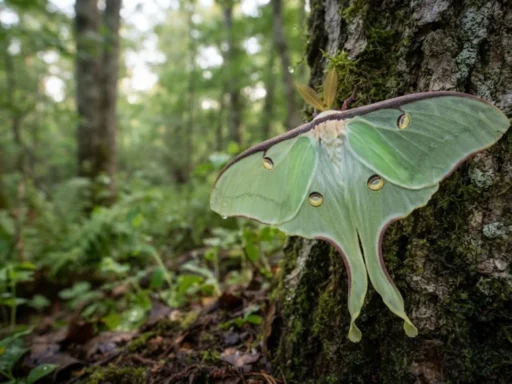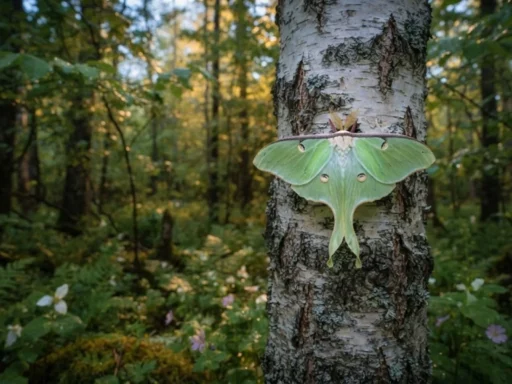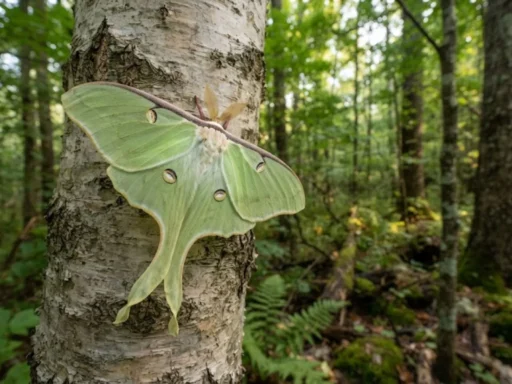

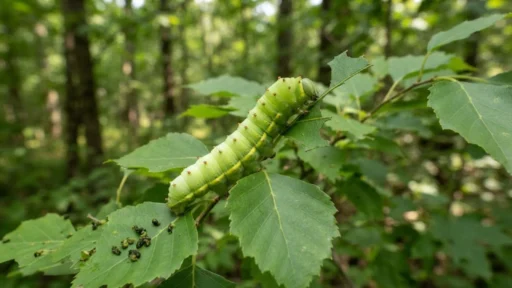
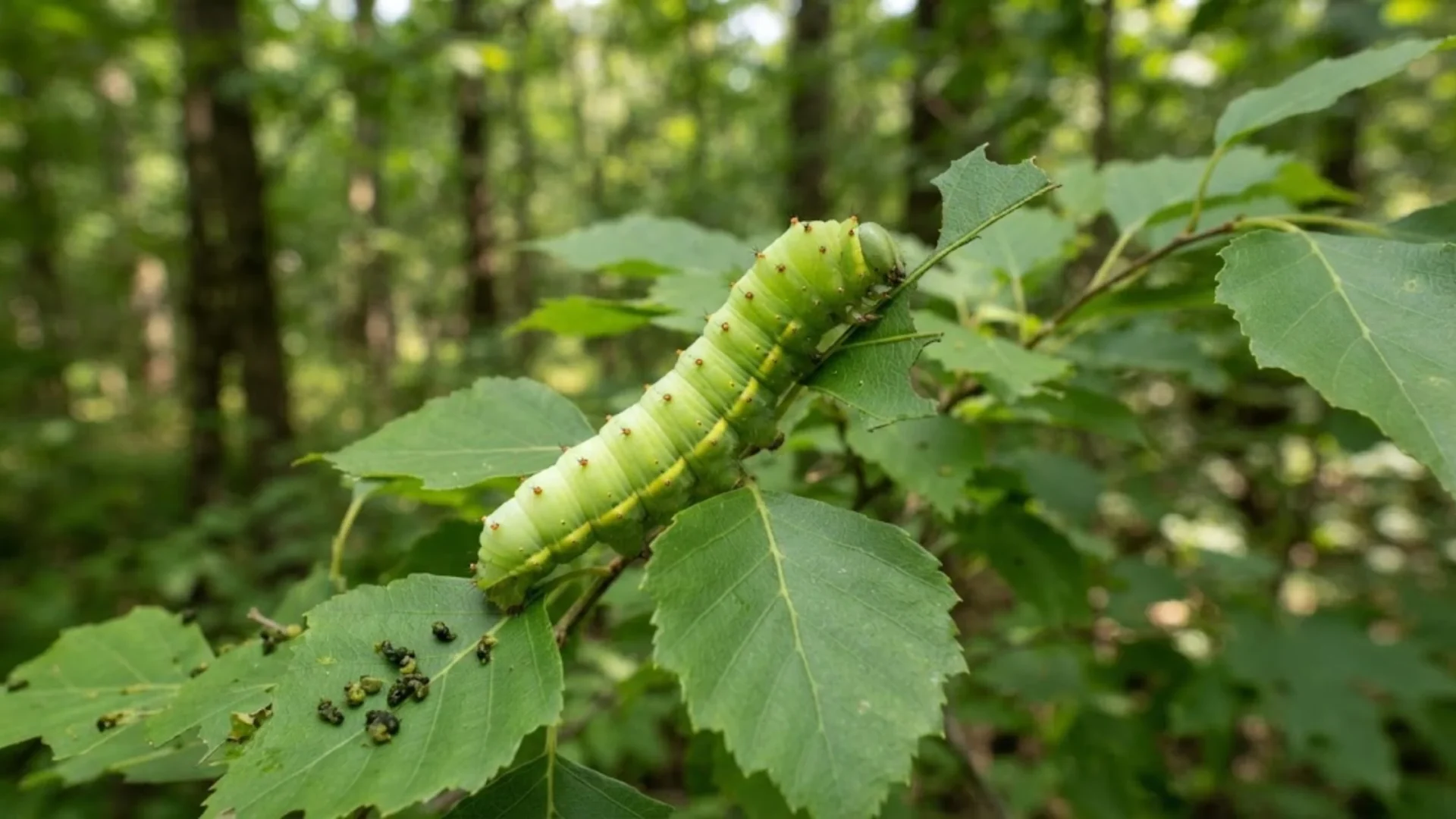
Luna Moth caterpillars eat only the leaves of certain trees and shrubs, mainly white birch, sweetgum, hickory, walnut, persimmon, and sumac. That leaf-only diet is all the energy a Luna Moth ever gets, because the adult moth has no working mouth and never feeds. At Solera Garden, we look at wildlife through the lens of your yard, so this guide covers which host plants matter where you live, how the caterpillar’s appetite changes as it grows, and what to do if you want to support (or temporarily care for) one.
The Short Answer: A Leaf-Only Diet From Host Trees
A Luna Moth caterpillar (the larva of Actias luna) is a leaf-chewer. It does not eat flowers, nectar, fruit, or other insects. It feeds on the foliage of a fairly short list of deciduous host plants, and the female moth lays her eggs directly on the undersides of those leaves so the caterpillars hatch on their first meal.
The most commonly reported Luna Moth host plants are:
| Host plant | Scientific name | Where it matters most |
|---|---|---|
| White (paper) birch | Betula papyrifera | Northern populations and cooler regions |
| American sweetgum | Liquidambar styraciflua | Mid-Atlantic and the South |
| Hickories | Carya spp. | Widespread; especially important in the South |
| Walnuts | Juglans spp. | Widespread; especially important in the South |
| Common persimmon | Diospyros virginiana | Southern and central regions |
| Sumacs | Rhus spp. | Widespread, including edges and smaller yards |
Beyond these core hosts, Luna Moth caterpillars have been recorded on other trees and shrubs, especially in the north, including alder, willow, and occasionally maple or oak. Treat those as secondary records rather than reliable hosts to plant for.
Why the Caterpillar Stage Is the Only Time a Luna Moth Eats
The Luna Moth caterpillar food supply has to cover the insect’s whole life. An adult Luna Moth emerges with reduced, non-functional mouthparts and lives roughly a week, running entirely on the fat and protein it stored as a larva.
That has two practical consequences for you:
- Healthy host trees produce healthy adults. If you want Luna Moths around, the leaves matter far more than any flower bed.
- There is no “food” to put out for adult moths. Bait, nectar feeders, and fruit won’t help a Luna Moth. Host plants, dark nights, and undisturbed leaf litter will.
If you want the full egg-to-adult picture, our guide to the Luna Moth life cycle from egg to adult walks through each stage in order.
Luna Moth Host Plants Change by Region
One of the most useful things to know about the Luna Moth larvae diet is that it isn’t the same everywhere. Luna Moths range across eastern North America, from southern Canada to the Gulf states, and local populations tend to favor the hosts that are common where they live.
- North and higher elevations: White birch is a key host. Northern populations usually have one generation a year, so caterpillars appear mainly in early to mid summer.
- Mid-Atlantic and South: Sweetgum, hickory, walnut, and persimmon carry more of the load. Warmer regions can have two or three generations a year, so you may find caterpillars from late spring into early fall.
- Everywhere in range: Sumac often shows up along woodland edges, fencelines, and sunny clearings.
What this means for you: Before you plant for Luna Moths, check which of these trees are native and already common near you. Your state’s Cooperative Extension office or native plant society can tell you which hosts local Luna Moths actually use. Planting a host that’s rare in your area may still help, but matching the local menu gives you the best odds.
How a Luna Moth Caterpillar’s Appetite Changes as It Grows
Luna Moth caterpillars grow through five instars (growth stages), shedding their skin between each one. Their eating changes a lot along the way.
- Hatching (1st instar): Tiny caterpillars, only a few millimeters long, start nibbling the tender leaf where they hatched. Damage at this point is almost invisible.
- Early instars (2nd–3rd): The caterpillar moves along the branch, eating leaf edges. It typically feeds alone rather than in groups, which helps it avoid predators.
- Late instars (4th–5th): This is when most of the eating happens. A full-grown caterpillar can reach roughly 2½–2¾ inches and will strip whole leaves down to the midrib.
- Pre-pupation: The caterpillar stops eating, empties its gut, often turns a reddish-brown color, and wanders to find a place to spin its cocoon among fallen leaves.
The whole caterpillar stage usually takes about three to five weeks, running faster in warm weather and slower in cool weather.
Will Luna Moth caterpillars hurt your trees?
In nearly all home landscapes, no. Luna Moth caterpillars feed alone and are rarely found in large numbers, so a mature tree can easily spare the leaves. You’ll usually see scattered chewed leaves on one or two branches, not defoliation. There is no need to spray for them, and doing so would remove a native moth that many gardeners work hard to attract.
How to Find Luna Moth Caterpillars Feeding in Your Yard
Large green caterpillars blend almost perfectly into host leaves, so look for their signs instead of the insect itself:
- Frass (droppings): Dark, barrel-shaped pellets on the ground, a deck, or a car parked under a host tree are often the first clue.
- Fresh leaf damage: Leaves eaten down to the center vein on lower branches of birch, sweetgum, hickory, walnut, persimmon, or sumac.
- Undersides of leaves: Caterpillars often rest on the underside of a twig or leaf during the day.
Once you spot one, compare it to the descriptions in our guide on how to identify a Luna Moth at every stage: a bright, translucent green body, a pale yellowish line along each side, and small reddish-orange bumps on each segment.
What to Feed a Luna Moth Caterpillar You Found
Sometimes a caterpillar falls from a tree during yard work or turns up somewhere unexpected. The best option is usually the simplest: place it back on the nearest host tree, ideally on the same species you found it under.
If you need to keep it briefly (for example, a classroom observation), follow these rules:
- Feed the plant it was already eating. Caterpillars that have fed on one host for a while can refuse a new species or eat poorly after a switch. If you found it under a walnut, give it walnut leaves.
- Use fresh, untreated leaves. Pick leaves from trees that haven’t been sprayed with insecticide, and avoid roadside branches.
- Replace leaves daily. Wilted or dried leaves won’t sustain a fast-growing larva. Keep cut stems in a narrow water vial with the opening blocked so the caterpillar can’t fall in.
- Don’t wet the leaves heavily. Excess moisture in a container encourages mold.
- Release it where it was found. Let it pupate and emerge in its home range rather than moving it far away.
Never offer lettuce, fruit, or other “general” foods. A Luna Moth caterpillar will only feed on its host plants.
How to Grow a Better Luna Moth Menu at Home
If you want Luna Moth caterpillars in your yard, think of it as stocking a pantry:
- Plant or protect a native host. A single sweetgum, birch, persimmon, hickory, walnut, or stand of sumac can support caterpillars for years. Our guide on how to attract Luna Moths to your yard compares these trees by size, soil, and region.
- Skip systemic insecticides. Products absorbed into leaves can make a host tree toxic to the caterpillars eating it.
- Leave the leaves under host trees. Mature caterpillars drop to the ground and spin cocoons inside fallen leaves, and the last generation of the year overwinters there. A gentler, wildlife-friendly approach to fall garden cleanup for pollinators keeps those cocoons safe.
- Move leaves instead of bagging them. If you have to clear a lawn or path, rake leaves into beds under the trees. If you plan to compost your fallen leaves, wait until late spring to collect from host-tree areas, after adults have had time to emerge.
- Dim your outdoor lights. Adults need darkness to find mates, and no mating means no eggs on your host plants.
Frequently Asked Questions
Do Luna Moth caterpillars eat oak leaves?
They have been recorded on oak in some northern areas, but oak is not a typical or reliable Luna Moth host. If you want to support them, plant one of the core hosts listed above.
Do Luna Moth caterpillars eat at night or during the day?
They can feed at any time, but many large caterpillars do more of their feeding at night and rest still on the undersides of leaves by day, which makes daytime spotting harder.
Are Luna Moth caterpillars poisonous to touch?
No. They don’t have stinging spines. If disturbed, they may rear up, make clicking sounds with their mandibles, or release a bitter fluid as a defense. Handle them gently, or not at all, and wash your hands afterward.
Your Next Step
Walk your yard and note which Luna Moth host plants you already have: birch, sweetgum, hickory, walnut, persimmon, or sumac. If you find one, protect it from sprays and leave the leaf litter beneath it this fall. If you don’t, choose one native host that suits your region and soil and plant it this season. That single tree can feed the next generation of Luna Moths long before you ever see an adult at your porch light.