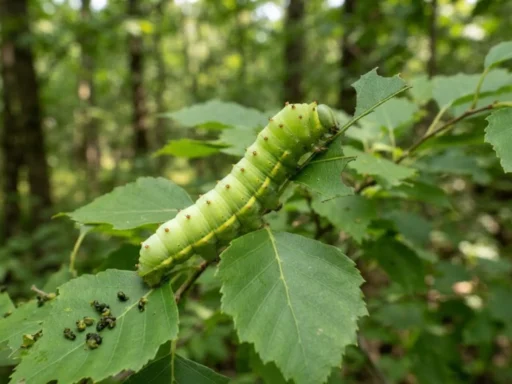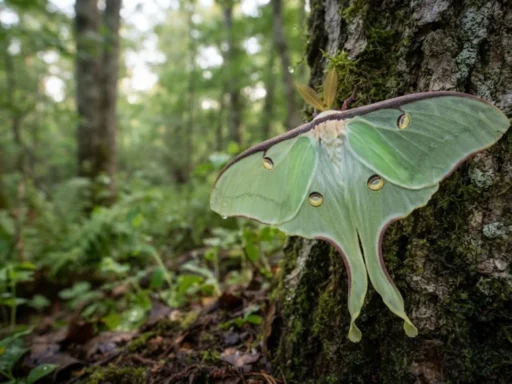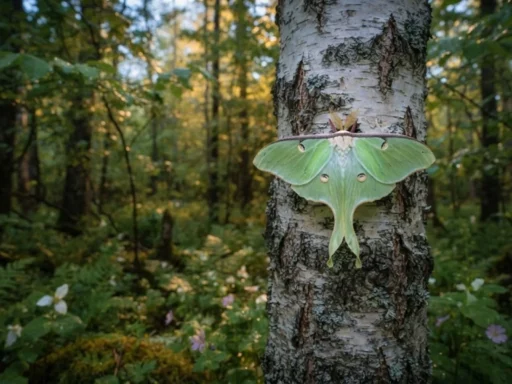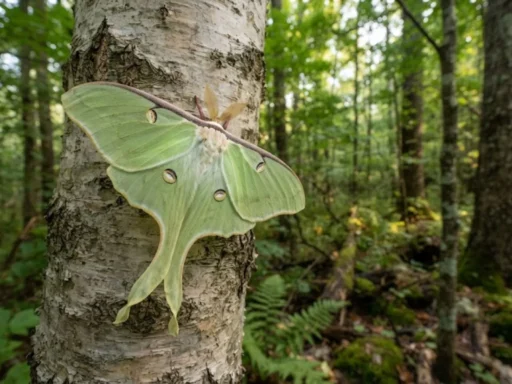

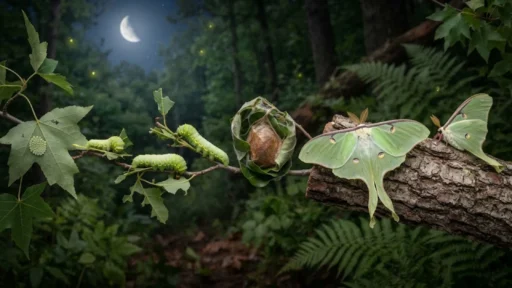
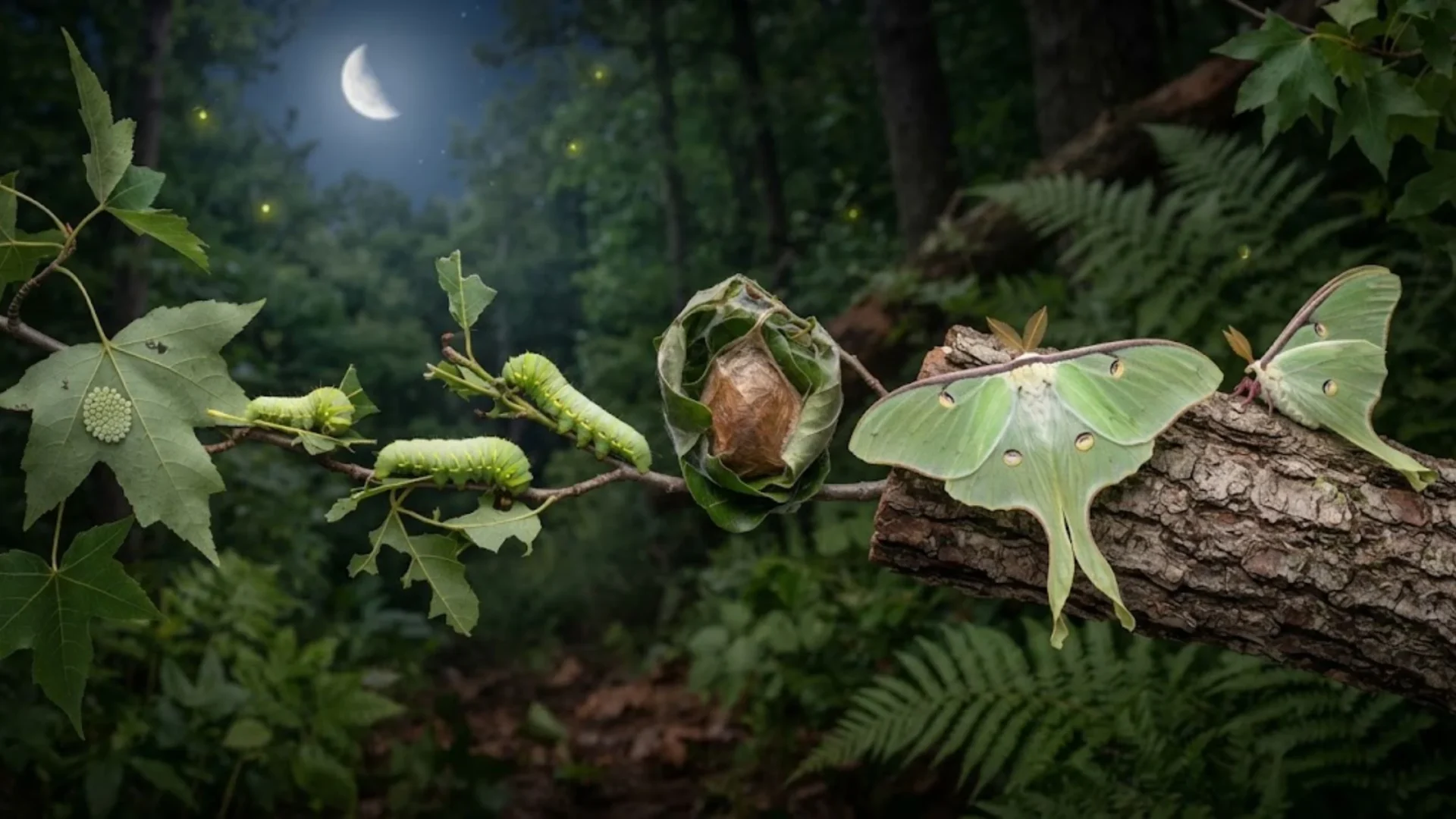
The Luna moth life cycle has four stages: egg, caterpillar (larva), cocoon (pupa), and adult moth. In warm weather, a single generation moves from egg to adult in roughly two to three months. The adult then lives only about a week, just long enough to mate and lay the next round of eggs. When summer ends, the last caterpillars of the year spin cocoons that rest in fallen leaves through winter and release adults the following spring.
This complete transformation is called metamorphosis, and the Luna moth (Actias luna) is one of the most visible examples of it in eastern North American gardens. Below, you’ll see what happens in each stage, how long it lasts, why the cycle repeats a different number of times depending on where you live, and where you’re most likely to find each stage in your own yard.
The Luna Moth Life Cycle at a Glance
Use this table as your quick reference. Durations shift with temperature, so treat them as typical ranges rather than fixed dates.
| Stage | What it looks like | Typical size | Typical duration | Main job |
|---|---|---|---|---|
| Egg | Tiny, slightly oval, white mottled with brown | About 2 mm long | About 1 week | Develop the first-stage caterpillar |
| Caterpillar (larva) | Bright green, solitary; molts through 5 instars | 6–8 mm at hatching; about 2–3 inches when full grown | About 4–7 weeks | Eat and store energy for the rest of the life cycle |
| Cocoon (pupa) | Thin, papery brown silk wrapped in leaves | Roughly the size of a walnut shell | About 2–3 weeks in summer; up to about 9 months over winter | Rebuild the caterpillar’s body into a moth |
| Adult moth | Pale green wings with long hindwing tails, 3–4 inches across | Wingspan about 3–4⅛ inches | About 7–10 days | Mate and lay eggs; adults do not eat |
If you want help confirming that the green moth or caterpillar you found is actually a Luna moth, our guide to what a Luna moth looks like and how to identify one covers each stage’s field marks and common look-alikes.
Stage 1: Luna Moth Eggs
Luna moth eggs are where every cycle begins, and they’re the stage you’re least likely to notice.
What they look like. Each egg is slightly oval and roughly 2 mm long, about the size of a sesame seed. The shell is white but mottled with brown from the adhesive the female uses to glue it to a leaf.
Where the female lays them. A mated female begins laying the evening after mating and continues over several nights. She places eggs singly or in small clusters, usually on the undersides of leaves on host trees such as white birch, sweetgum, hickory, walnut, persimmon, and sumac. Spreading eggs across leaves and nights means no single predator or storm wipes out the whole batch.
How many and how long. A female can lay a few hundred eggs over her short life. The eggs hatch in about a week, a little faster in warm weather and slower in cool weather.
What this means for you: You almost never need to “protect” Luna moth eggs directly. The most useful thing you can do is keep host trees healthy and avoid spraying broad-spectrum insecticides on their foliage during the growing season, when eggs and young caterpillars are present.
Stage 2: The Luna Moth Caterpillar
The caterpillar stage is the engine of the whole Luna moth life cycle. Everything the adult moth will ever use, it gains here, because the adult has no working mouthparts.
Five instars, five molts
A Luna moth caterpillar grows in five stages called instars. At the end of each instar, it sheds its skin (molts) so its body can expand. Sizes from University of Florida entomology research show how dramatic that growth is:
| Instar | Approximate length |
|---|---|
| 1st | 6–8 mm |
| 2nd | 9–10 mm |
| 3rd | 13–15 mm |
| 4th | About 23 mm |
| 5th (full grown) | About 55–70 mm (2⅛–2¾ inches) |
The full caterpillar stage usually lasts a month or longer depending on temperature, with each instar taking several days to more than a week.
How caterpillars feed and defend themselves
Luna moth caterpillars feed alone rather than in groups, and they stay on the leaves of their host tree. Northern populations rely heavily on white birch, while southern populations commonly use walnut, hickory, sumac, sweetgum, and persimmon.
Their bright green color blends into foliage, which is their first line of defense. If disturbed, a caterpillar may rear up the front of its body, make audible clicking sounds with its mandibles, and regurgitate fluid that deters predators. If you ever pick one up and hear clicking, that’s normal defensive behavior. Put it back on its leaf.
The “gut purge” before the cocoon
When the caterpillar finishes feeding, it empties its gut of food and excess water. During this time, it may change color and wander away from where it was eating, often down the trunk, while it looks for a place to spin. Many gardeners find Luna moth caterpillars at exactly this moment, crawling across a patio or walkway, and assume something is wrong. Usually nothing is. If you move one out of harm’s way, place it in leaf litter under the nearest host tree.
Stage 3: The Cocoon and Pupa
The cocoon stage is where Luna moth metamorphosis happens out of sight.
The cocoon. The caterpillar spins a thin, single-layered silk cocoon and wraps it in leaves. Some cocoons are spun among leaves still on the tree and drop to the ground when the leaves fall in autumn. Others are spun in leaf litter on the ground. Either way, the finished cocoon looks like a crumpled brown leaf.
The pupa. Inside the cocoon, the caterpillar becomes a pupa. During this stage, its body is reorganized into the structures of an adult moth, including wings, antennae, and reproductive organs.
How long it lasts. In summer, the pupal stage usually lasts about two to three weeks before the adult emerges. Cocoons formed late in the season do something different: they enter diapause, a hormonally controlled resting state, and stay dormant through winter. Research summarized by the University of Florida shows that caterpillars exposed to short day lengths produce diapausing pupae, while caterpillars exposed to long days produce pupae that develop straight through. In other words, the shortening days of late summer tell the last brood to wait until spring.
What this means for you: In fall and winter, Luna moth cocoons are lying in the leaves under and around host trees. This is the stage most easily destroyed by routine yard work. Mowing, shredding, leaf blowing, and bagging leaves under host trees can all kill overwintering pupae. Our fall garden cleanup guide for pollinators explains which leaves and stems to leave in place and which areas you can still tidy.
Stage 4: The Adult Luna Moth
The adult stage is the shortest part of the Luna moth life cycle, and it has only one purpose: reproduction.
Emergence and wing expansion
Adults usually emerge from their cocoons in the morning, and males typically start emerging several days before females. A newly emerged moth has small, crumpled wings. It climbs to a perch and pumps fluid into the wing veins, which takes a couple of hours, before the wings are firm enough to fly. If you find a moth with soft, limp wings hanging below a branch, leave it alone. Handling it at this point can permanently damage the wings.
Mating at night
Luna moths are active at night. A female releases a sex pheromone that males detect with their broad, feathery antennae, sometimes from a considerable distance. Mating usually starts after midnight and can last several hours. The female begins laying eggs the following evening, which starts the cycle again.
Why adults live only about a week
Adult Luna moths have vestigial (non-functional) mouthparts and do not eat. They live on the energy the caterpillar stored, which is why most adults survive only about seven to ten days. This is also why nectar flowers do not help adult Luna moths: the plants that matter are the trees their caterpillars eat.
The long, twisted tails on the hindwings are not just decoration. Researchers believe the spinning tails interfere with the echolocation of hunting bats, drawing an attack toward the tail rather than the body.
How Many Times a Year Does the Cycle Repeat?
The number of complete Luna moth life cycles per year, called broods or generations, depends mostly on how long your warm season lasts.
| Region | Generations per year | What you’ll typically see |
|---|---|---|
| Canada and the northern U.S. (around Michigan and north) | 1 | Adults in late spring to early summer; the year’s caterpillars become overwintering cocoons |
| Mid-latitudes such as the Ohio Valley and Mid-Atlantic | 2 | A spring brood of adults, then a second brood in mid to late summer |
| Southern U.S. | 3 | Adults as early as March; in Louisiana and Florida, adults may appear in any month |
Brood timing also affects appearance. Spring-brood adults tend to be a deeper green with reddish-purple wing margins, while later broods are often paler and more yellowish. That difference doesn’t change the life cycle, but it explains why two Luna moths you see in the same yard months apart can look slightly different.
Where to Find Each Stage in Your Yard, Season by Season
This is the practical way to think about the Luna moth life cycle as a gardener: at any time of year, at least one stage is likely present if your yard has host trees.
| Season | Most likely stage | Where to look | What to avoid |
|---|---|---|---|
| Spring | Adults emerging; first eggs | Tree trunks, shrubs, and walls near host trees in early morning | Raking or blowing leaves under host trees before adults have emerged |
| Summer | Eggs, caterpillars, summer cocoons, later-brood adults | Undersides of host tree leaves; caterpillars wandering near trunks before pupating | Spraying insecticides on host trees; bright all-night outdoor lighting |
| Fall | Final caterpillars and overwintering cocoons | Leaf litter beneath birch, sweetgum, hickory, walnut, persimmon, and sumac | Shredding, mowing, or bagging leaves under host trees |
| Winter | Cocoons in diapause | Inside the leaf layer on the ground | Hauling away the leaf layer or burning leaves |
If you need to manage fallen leaves, you can still keep a protective zone. Leave the layer intact beneath host trees and move or process leaves elsewhere in the yard. When you do collect leaves from open areas, our guide to composting leaves in fall shows how to turn them into a useful soil amendment. If you prefer a tidier look, using leaves as a light top layer is covered in our garden mulching guide. Avoid shredding leaves gathered from directly under host trees, since cocoons may be hidden among them.
How to Support the Luna Moth Life Cycle in Your Garden
Each stage of the life cycle has one weak point you can influence:
- For eggs and caterpillars: Plant or keep native host trees suited to your region, and avoid broad-spectrum insecticides on their foliage.
- For cocoons: Leave leaf litter under host trees through winter, and wait until adults would have emerged in your area before cleaning those beds in spring.
- For adults: Reduce all-night outdoor lighting. Lights can pull moths away from mates and expose them to predators during their very short adult life.
- For every stage: Watch rather than collect. If you need to move a caterpillar or adult out of danger, place it on or under the nearest host tree.
For tree choices by region and a full yard setup, see our guide on how to attract Luna moths with host trees.
Conclusion
The Luna moth life cycle runs from a sesame-sized egg to a caterpillar that grows through five instars, to a leaf-wrapped cocoon where metamorphosis happens, to an adult that lives about a week without eating. Depending on where you live, that cycle repeats one to three times a year, and the final generation spends the winter as a cocoon in your fallen leaves.
Your next step: this fall, find out whether you have a birch, sweetgum, hickory, walnut, persimmon, or sumac in your yard. If you do, mark the area beneath it as a no-shred, no-bag zone until late spring. That single change protects the stage of the Luna moth life cycle that gardeners most often destroy by accident.
Frequently Asked Questions
How long does the Luna moth life cycle take from egg to adult?
In warm weather, a summer generation typically goes from egg to emerging adult in about six to ten weeks: around one week as an egg, roughly four to seven weeks as a caterpillar, and about two to three weeks as a pupa. The overwintering generation takes much longer because the pupa can rest for up to about nine months.
Can you raise Luna moths from eggs at home?
Some educators and hobbyists rear Luna moths from captive-bred eggs, which requires a steady supply of fresh leaves from the correct host tree. If you’re considering it, check your state or provincial rules, buy only from captive-bred sources, and release adults only where the species naturally occurs. Don’t collect wild adults or cocoons.
Do Luna moths die after laying eggs?
Yes. Adults don’t feed, so they survive only on stored energy. Females usually die within a few days of finishing egg-laying, and most adults live about seven to ten days in total.
What does a Luna moth cocoon look like in the leaves?
It looks like a small, crumpled brown leaf bundle with thin papery silk visible underneath. Because it blends in so well, assume any undisturbed leaf litter under a host tree may contain cocoons.