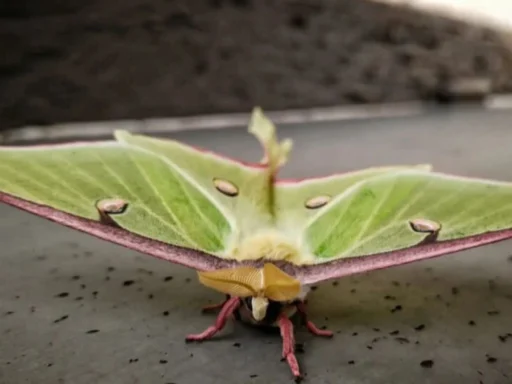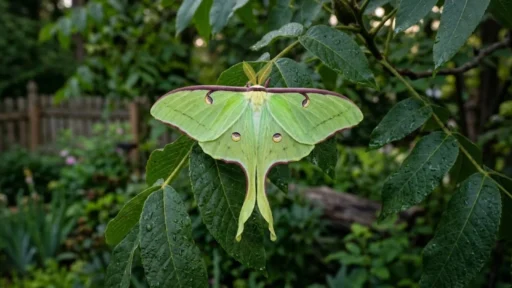
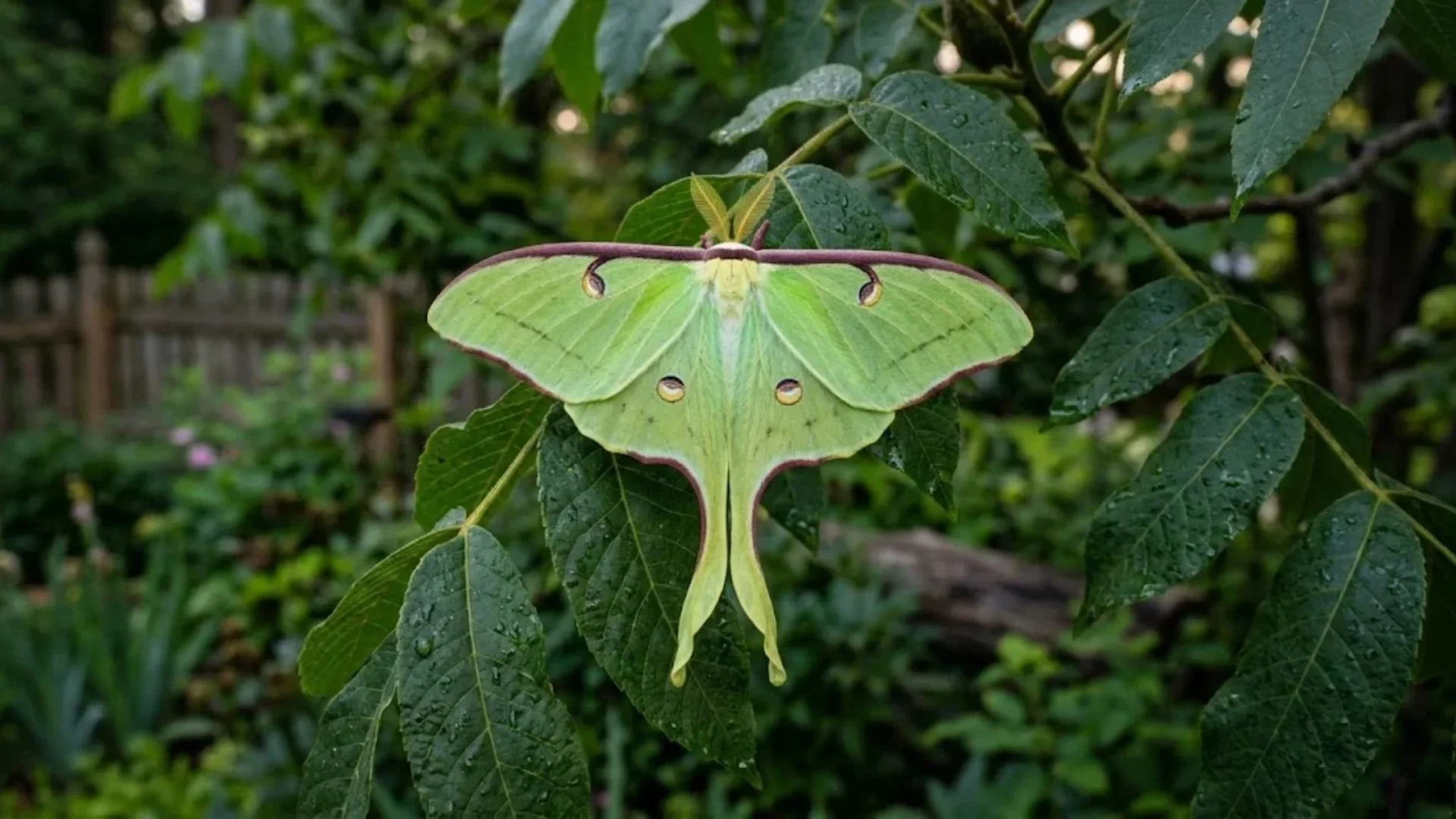
No, Luna moths are not rare. They’re widespread across eastern North America and rated “Secure” by the conservation group NatureServe. They are rarely seen, though, because each adult lives only about a week and flies at night. Here at Solera Garden, we’ve written a full series on these pale-green silk moths. In this guide, you’ll learn why so few people spot them, what is lowering the Luna moth population in some areas, and the simple yard changes that matter most for Luna moth conservation.
Rare vs. Rarely Seen: The Direct Answer
The Luna moth (Actias luna) is a giant silk moth in the family Saturniidae. It is:
- Not endangered. It isn’t listed as threatened or endangered at the federal level in the U.S.
- Widespread. It ranges from southern Canada through the eastern United States, from Maine to Florida and west to roughly eastern Texas and the eastern Dakotas.
- Considered secure overall. NatureServe ranks the species as “Secure.”
So when you ask “are Luna moths rare?”, the accurate answer has two parts. The species as a whole is doing fine. Your local Luna moths may still be scarce if your area lacks what they need.
Why You Almost Never See One
A common moth can feel rare when its life is built to avoid notice. Three things work against you seeing a Luna moth:
| Reason | What’s happening | What it means for you |
|---|---|---|
| Short adult life | Adults have no working mouthparts and live about 7 to 10 days | The window to see any one moth is tiny |
| Night flight | Adults fly after dark, and males follow scent to find females | You’ll mostly see them near lights or resting the next morning |
| Seasonal timing | One generation a year in the far north, often two or more farther south | Outside those weeks, there are no adults to see |
| Daytime camouflage | Adults rest motionless among green leaves | One may be close by without you noticing it |
Most of a Luna moth’s life is spent as an egg, a leaf-colored caterpillar high in a tree, or a cocoon hidden in fallen leaves. Our guide to when Luna moths come out and what time of year they’re active shows you which weeks to watch in your region.
What Affects the Luna Moth Population Locally
Even a secure species can thin out locally. These are the main pressures, from best documented to more general.
1. An introduced parasitoid fly
Compsilura concinnata is a fly introduced to North America repeatedly from 1906 onward to control gypsy moths (now called spongy moths) and other pests. The fly doesn’t target only pests. It lays live larvae inside the caterpillars of many native moths and butterflies.
In a Massachusetts field study published in 2000, the fly caused 81% of the deaths of young cecropia caterpillars. Cecropia moths are giant silk moths closely related to the Luna moth. Researchers have also linked the fly to harm to Luna moth populations. This is the best-documented reason giant silk moths have declined in parts of New England.
You can’t remove this fly from your yard. It is, however, a good reason to protect the caterpillars that do survive.
2. Loss of host trees
Luna moth caterpillars eat the leaves of specific trees, including birch, sweetgum, hickory, walnut, persimmon, and sumac. Where mature native trees are cleared, the moths have nowhere to lay eggs. Our article on what Luna moth caterpillars eat lists host trees by region.
3. Leaf-litter cleanup
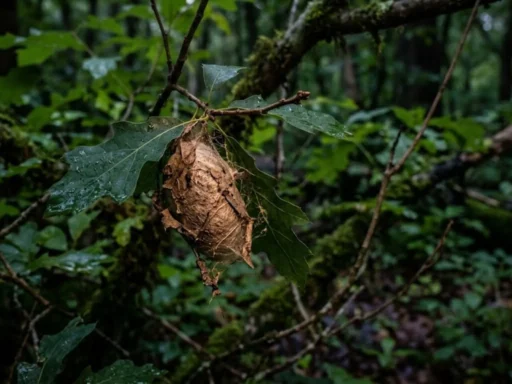
Luna moth cocoons overwinter in the leaf litter under host trees. Raking, blowing, and bagging every leaf in fall can remove next spring’s moths along with the leaves.
4. Night lighting
Bright outdoor lights draw moths out of cover. A Luna moth that circles a porch light all night wastes energy it can’t replace, can miss its chance to mate, and becomes easy prey at dawn.
5. Caterpillar-killing sprays
Broad-spectrum insecticides kill caterpillars, and so do Bt (Bacillus thuringiensis) products sold for caterpillar control. Bt is often marketed as a gentle option, but the common caterpillar strain affects moth and butterfly larvae in general, not just pest species.
A Gardener’s Checklist: Why You’re Not Seeing Luna Moths
Use this to diagnose your own yard:
- No host trees nearby? Plant a native host tree suited to your region, or protect the ones you have.
- Leaves cleared to bare soil every fall? Leave a patch of leaf litter under trees through winter. Our fall garden cleanup guide for pollinators shows you how to tidy up without removing overwintering insects.
- Bright white lights on all night? Switch to warm amber bulbs, motion sensors, or simply turn lights off.
- Spraying for caterpillars? Spot-treat only real problems, and skip Bt sprays near host trees.
- Outside Luna moth range? If you live in the Rockies, the Southwest, or the Pacific Coast, wild Luna moths don’t occur there. Check our page on where Luna moths live and their natural habitat.
What to Do If You Find a Luna Moth
Seeing one means your area still supports a breeding population, which is good news. To help it:
- Leave it where it is. Luna moths rest by day and fly off at night on their own.
- Don’t handle it. Touching rubs scales off the wings, and the moth can’t feed to recover.
- Turn off nearby lights that evening. This lets it move on instead of circling.
- Take a photo instead. You can report sightings to community science platforms such as iNaturalist, which helps track where Luna moths are found.
Conclusion: Common Moth, Local Responsibility
Luna moths aren’t rare, endangered, or in global trouble. They’re a secure, widespread species that most people simply never notice. What decides whether you see them is local: native host trees, leaf litter left in place, dark nights, and fewer caterpillar sprays.
Your next step: pick one change you can make this season, such as leaving the leaves under one tree or switching your porch light to amber. For a full yard plan, follow our guide on how to attract Luna moths with host trees and the right yard setup.
Frequently Asked Questions
Are Luna moths endangered?
No. Luna moths aren’t federally listed as threatened or endangered, and NatureServe ranks the species as “Secure.”
Is it bad luck or a rare event to see a Luna moth?
It’s not bad luck. Seeing one is less common than seeing many other moths because adults live only about a week and fly at night, but the species itself isn’t rare.
Can you buy or release Luna moths to boost local numbers?
Some suppliers sell Luna moth eggs or cocoons, but releasing them isn’t a substitute for habitat. Without host trees, leaf litter, and dark nights, released moths have little to support the next generation. Check your local rules before releasing any insect.