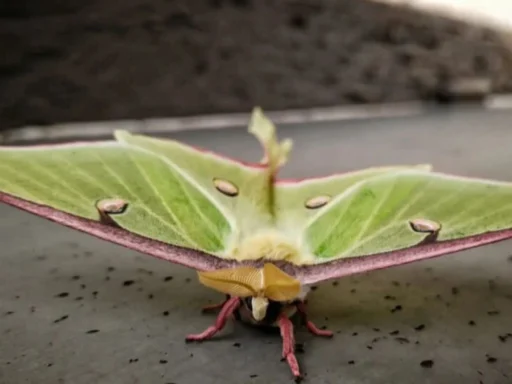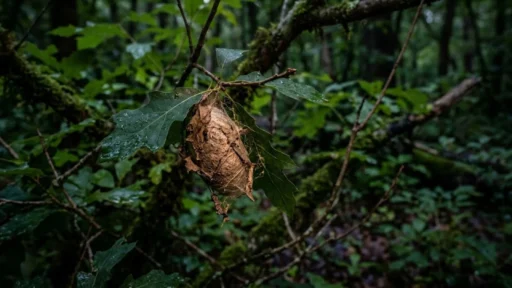
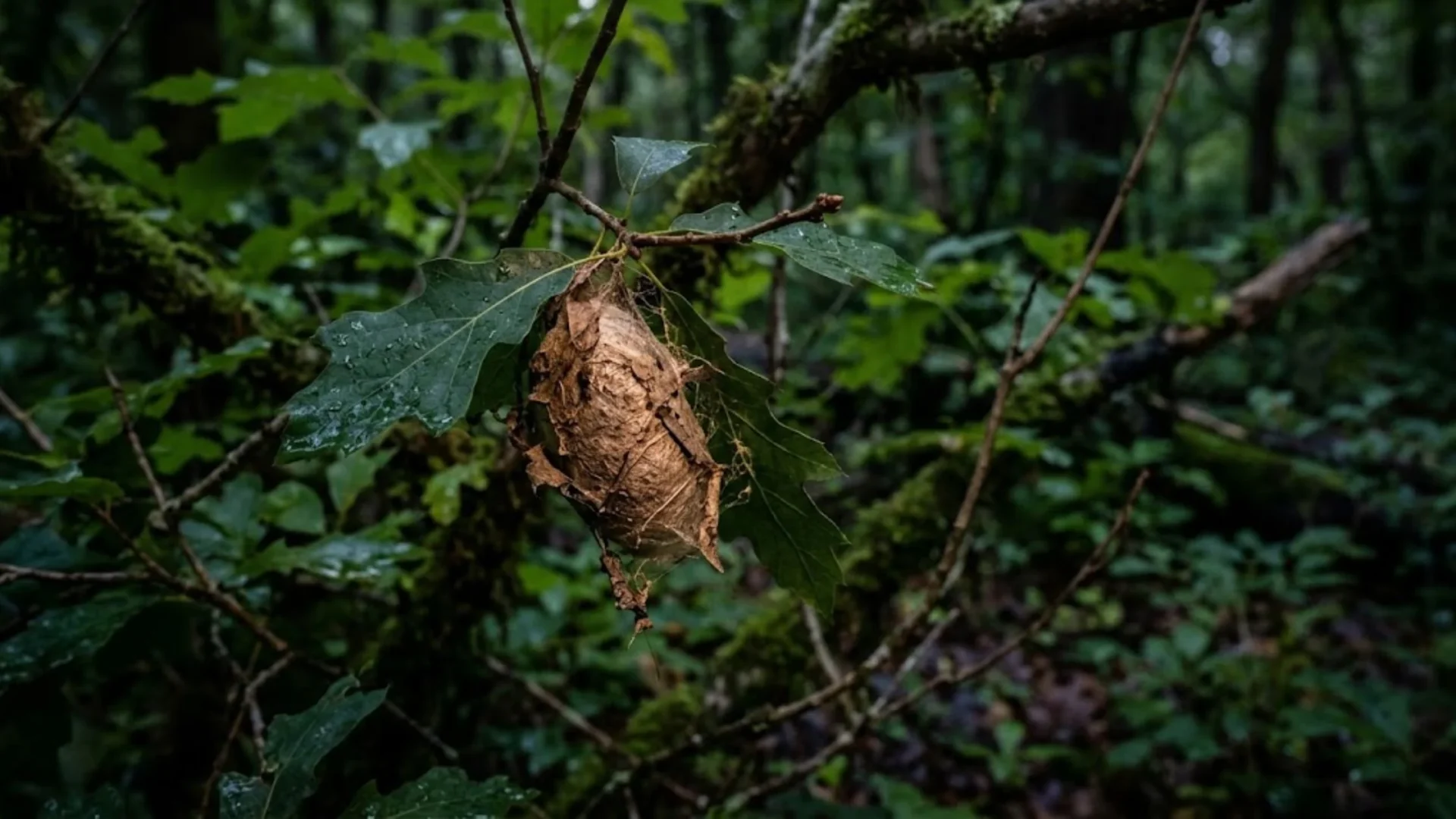
At Solera Garden, we get a lot of questions about that leaf-wrapped bundle under a walnut or sweetgum tree. If you find one, it’s a Luna moth cocoon, and it’s doing more than it looks like. Inside, a green caterpillar breaks down most of its own body and rebuilds it as a winged adult. Then the adult saws its way out with a pair of spurs on its back. This guide walks you through each stage inside the cocoon, how long the Luna moth pupa stays there, and what happens during Luna moth emergence. It also covers what you should and shouldn’t do if you find one.
The short answer
Inside the cocoon, the caterpillar sheds its skin one last time and becomes a pupa. Inside the pupa’s hard case, larval tissues break down and adult structures form: wings, antennae, legs and reproductive organs. In summer this takes about two to three weeks. Cocoons spun late in the season go dormant (diapause) and can wait about nine months, until spring. When the adult is ready, it splits the pupal case, cuts through the silk with spurs near its wing bases, and crawls out to pump up its wings.
Step 1: The caterpillar builds the cocoon
The cocoon is the caterpillar’s last project. A fully grown, fifth-instar caterpillar stops eating, and its body empties and shrinks. If you want to know what fuels it up to this point, see what Luna moth caterpillars eat before they become adults.
The caterpillar spins a thin, single-layer silk cocoon and binds leaves around it. That’s why a finished Luna moth cocoon looks like a crumpled brown leaf and not a neat silk capsule.
Where the cocoon ends up matters for you:
- Some are spun among leaves still on the tree. Those cocoons fall to the ground when the leaves drop in autumn.
- Others are made directly in the leaf litter on the ground.
- Unlike polyphemus moth cocoons, Luna moth cocoons usually aren’t anchored to a twig. In fall and winter, most of them are lying in the leaves under and around host trees.
Step 2: The last molt and the pupa takes shape
Inside the silk, the caterpillar sheds its skin a final time and becomes a pupa. A Luna moth pupa is obtect: its developing wings, legs and antennae are fused flat against its body under a hard brown case. Most of its abdominal segments can’t move freely.
At the rear end, a cluster of tiny hooks called the cremaster grips a silk pad at the back of the cocoon. This holds the pupa in place, which matters later when the adult needs leverage to push its way out.
The pupa isn’t completely still, though. Luna moth pupae are more active than most moth pupae. If something disturbs the cocoon, the pupa wriggles inside its case and can make an audible noise.
Step 3: The body is rebuilt from the inside
This is the “magic” stage, and it’s real biology. Like all butterflies and moths, a Luna moth goes through complete metamorphosis. Inside the pupal case:
- Most larval tissues break down. Structures the caterpillar needed for chewing leaves and crawling are dismantled.
- Clusters of cells that were dormant in the caterpillar take over. These groups of cells were set aside early and now grow into adult wings, legs, antennae, compound eyes and reproductive organs.
- Some energy goes straight into the adult. Adult Luna moths have only vestigial mouthparts and no working digestive system. Everything the adult needs to find a mate and lay eggs comes from fat stored during the caterpillar stage.
That last point explains a lot about the adult stage. The moth that comes out of the cocoon will never eat. It lives for about a week on what it carried through the pupa. For the full picture, see how long Luna moths live as adults.
Step 4: Wait two weeks, or nine months
How long the pupa stays in the cocoon depends on when it formed:
| Cocoon formed | What happens inside | Typical time in cocoon |
|---|---|---|
| Early or mid-season (long days) | Development continues without pausing | About 2–3 weeks |
| Late season (shortening days) | The pupa enters diapause, a hormone-controlled pause | Up to about 9 months, emerging in spring |
Researchers have found that caterpillars raised under short day lengths produce diapausing pupae, and those under long day lengths don’t. Genetics and temperature also play a role. In practice, that means the last brood of the year spends the whole winter as a pupa in the leaf litter.
That’s why the number of broods, and the month you see adults, changes with your latitude. If you want to know when to look in your area, see when Luna moths come out and what time of year they’re active.
Step 5: The adult breaks out of the pupal case
When development is complete, a fully formed moth is packed inside the pupal case. It splits the case at the front (head) end and pushes the top section up. Then it works its head, thorax and wings free of the old skin.
But it’s still inside the silk cocoon, and that’s the harder exit.
Step 6: The moth cuts its way out of the cocoon
This is the part of Luna moth emergence most people never see. Many silk moths soften their cocoons with fluid. In his 1967 study, Priddle described the Luna moth cutting through the silk mechanically instead:
- The moth has a pair of hard chitinous spurs on its thorax, just above where the front wings attach. Each spur tapers to a polished, spear-shaped tip.
- As the moth raises and lowers its still-undeveloped wings, the spurs sweep through an arc of about 40–45 degrees. They saw against the silk threads.
- Between bursts of effort, the moth rotates a little inside the cocoon. Over the whole emergence it turns several times, so the spurs tear a roughly circular opening.
- The process can be loud. Priddle reported rhythmic scratching that could be heard about 20 feet away.
After emergence, the spurs fold flat and disappear under the thorax scales, so you won’t see them on an adult on your porch.
Step 7: The first hours outside
A newly emerged Luna moth doesn’t look like the moth you know yet:
- Swollen abdomen, small wings. The wings come out soft, wet and crumpled.
- It climbs to a perch. The moth needs to hang so its wings can expand.
- It pumps hemolymph into the wings. Over the first couple of hours, fluid moves from the abdomen into the wing veins until the wings reach full size.
- It drips meconium. During its first day, the moth releases a reddish liquid. This is waste from the old larval tissues, not blood or a sign of injury.
- It flies that night. Adults usually emerge in the morning, which leaves the day for the wings to dry and harden before evening flight. Males generally emerge several days before females.
If you want to confirm what you’re looking at once the wings are open, see how to identify a Luna moth.
How to tell a male pupa from a female
If you’re raising Luna moths or looking at a pupa that has come out of its cocoon, you can sometimes tell the sex before emergence. Female pupae have two lengthwise notches on the underside of the fourth and fifth visible abdominal segments. Males don’t have these notches. Look gently and briefly, and return the pupa to a sheltered spot.
What to do if you find a Luna moth cocoon
Use these rules of thumb:
- Leave it where you found it if you can. The cocoon is built for outdoor conditions. If it’s in a spot you need to clear, move it with its leaf wrapping onto leaf litter under a nearby host tree.
- Don’t open it to check. The silk and leaves are its protection. Cutting into the cocoon can expose or injure the pupa.
- Avoid shaking it to see if it’s alive. A living pupa may wriggle when disturbed, but repeated disturbance is stress it doesn’t need.
- Keep overwintering cocoons outdoors. Temperature is one of the signals that triggers emergence. Bringing a cocoon into a heated house could throw off its timing. This is an inference from how diapause works, not a measured outcome.
- Leave the leaves under host trees. Mowing, shredding, blowing and bagging leaves in fall can destroy pupae you never knew were there.
That last point is the biggest thing you can do as a gardener. For which trees count as host trees and the habitat Luna moths need, see where Luna moths live and what their natural habitat looks like.
Conclusion
A Luna moth cocoon is a work zone. The caterpillar takes itself apart, rebuilds as an adult, waits weeks or months for the right signal, and then cuts its way out with built-in spurs. If you have walnut, hickory, sweetgum, persimmon or birch trees nearby, the best next step is simple: leave a patch of fallen leaves under them this fall. That leaf layer may be where next spring’s Luna moths are waiting.
Frequently asked questions
Can you tell if a Luna moth cocoon is still alive?
Not reliably without disturbing it. A living pupa may wriggle when the cocoon is moved, but an empty cocoon has a clear round exit hole at one end. If there’s no hole, assume it’s still alive and leave it be.
Why is there red liquid where a Luna moth emerged?
That’s meconium, the waste left over from the caterpillar’s tissues. It’s normal and usually appears during the moth’s first day.
Do Luna moths emerge at night?
Usually not. Most adults emerge in the morning so their wings can expand and harden during the day. They become active and fly after dark.