No, adult Luna moths don’t eat. A Luna moth does all of its feeding as a caterpillar, chewing the leaves of a short list of host trees. The adult that emerges from the cocoon has only vestigial (leftover, non-working) mouthparts and lives for about a week on fat it stored as a caterpillar. In this guide, you’ll learn how Luna moth feeding habits change from caterpillar to adult, why the adult can’t eat, how that compares with moths that do sip nectar, and what it means for how you help Luna moths in your garden.
The short answer: one stage eats, the other doesn’t
Here’s how feeding works across the Luna moth’s four life stages:
| Life stage | Does it eat? | What it eats | Roughly how long |
|---|---|---|---|
| Egg | No | Nothing; the embryo uses the yolk | About a week or two |
| Caterpillar (larva) | Yes, constantly | Leaves of host trees and shrubs | About 3–5 weeks |
| Pupa (in the cocoon) | No | Nothing; it uses stored reserves | About 2–3 weeks, or months if overwintering |
| Adult moth | No | Nothing; it has no working mouth | About 7–10 days |
The caterpillar is the only stage that takes in food. Everything the adult does, flying, finding a mate and laying eggs, runs on what the caterpillar ate weeks or months earlier. For the full sequence, see the Luna moth life cycle from egg to adult.
Why adult Luna moths can’t eat
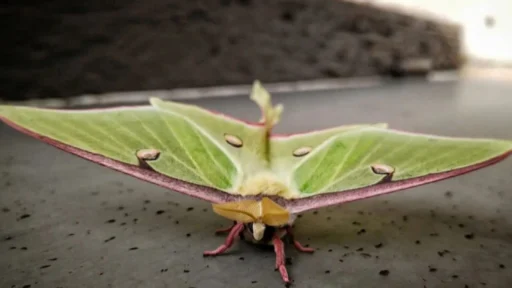
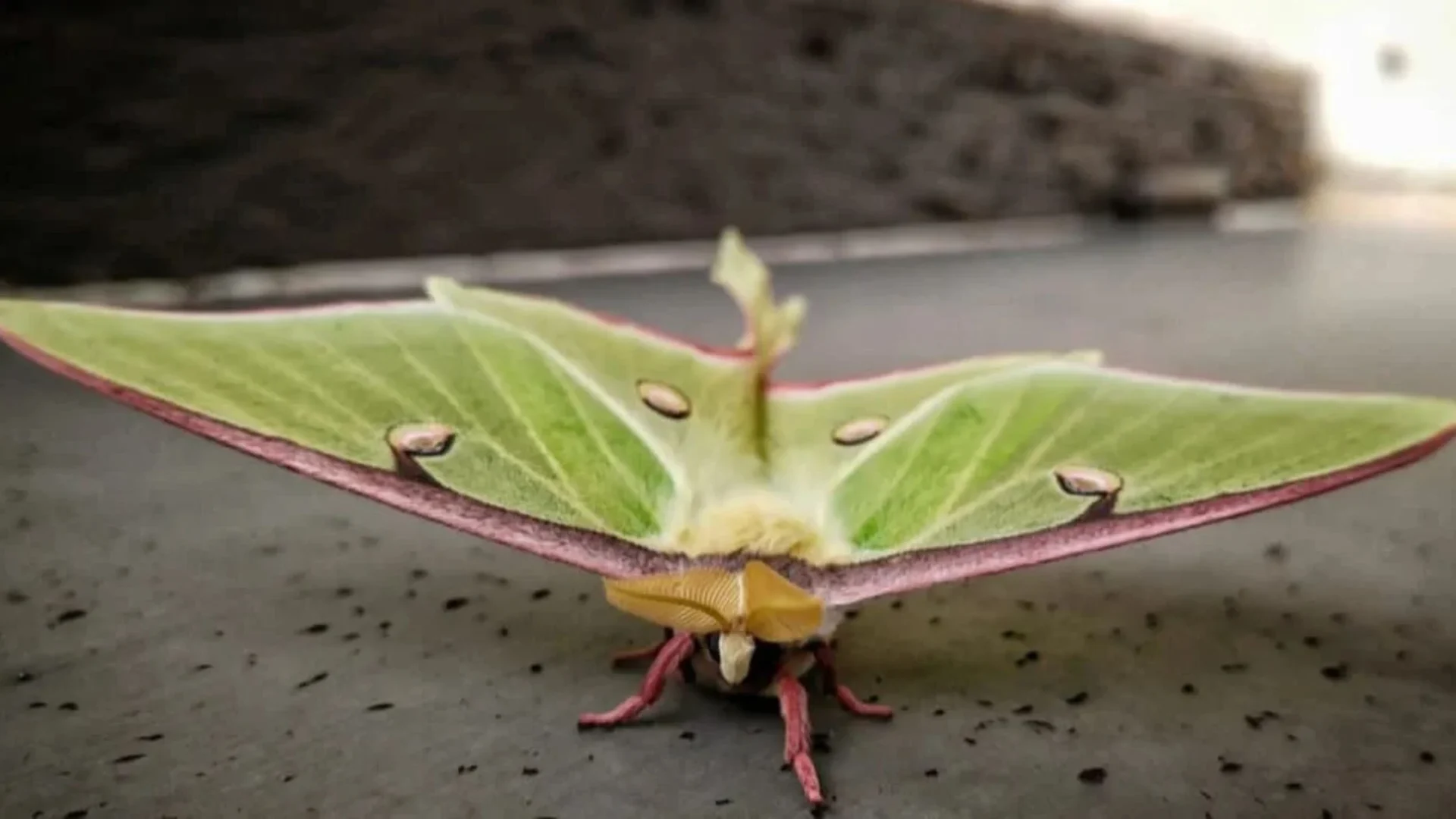
Adult Luna moths have vestigial mouthparts. The structures are still there in reduced form, but they don’t work, and adults have no functioning digestive system. Many moths and butterflies sip nectar through a long, coiled feeding tube called a proboscis. An adult Luna moth has no working proboscis to uncoil.
That design fits the adult’s single job. The adult Luna moth diet is, in effect, the fat and protein its caterpillar stored. Those reserves power three things:
- Pumping up the wings after emergence
- Flying at night to find a mate (males track female scent with their feathery antennae)
- Laying eggs on host leaves, which females start doing the night after mating
When the reserves run out, the moth dies. That’s why the adult stage is so short. If you want to know what limits that week, see how long Luna moths live.
Luna moths aren’t unusual among their relatives
Luna moths belong to the giant silk moth family (Saturniidae). Several of their best-known relatives, such as cecropia and polyphemus moths, also have reduced mouthparts and don’t feed as adults.
Compare that with sphinx moths (hawk moths), which hover at flowers like hummingbirds and drink nectar through a long proboscis. If you see a large moth feeding at your flowers at dusk, it’s not a Luna moth.
Luna moth caterpillar feeding: where all the eating happens
Because the adult can’t eat, the caterpillar has to eat enough for its whole life. Luna moth caterpillar feeding has a few features worth knowing:
- It’s leaves only. Caterpillars eat the foliage of specific trees and shrubs, not flowers, fruit or nectar.
- The host list is short and regional. White birch is the main host in the north. Further south, caterpillars use sweetgum, hickories, walnuts, persimmon and sumacs. Different populations seem adapted to different hosts, so a tree that works in one region may not work in another.
- Most eating happens late. The caterpillar passes through five instars (growth stages between molts). It goes from a few millimeters long at hatching to about 2½ inches, and the last two instars do the heaviest feeding.
- The damage is minor. Luna moth caterpillars are never common enough to seriously damage their host trees, so you don’t need to protect your trees from them.
- Feeding stops before the cocoon. A fully grown caterpillar stops eating, empties its gut and wanders off to spin its cocoon among fallen leaves.
For the full host-plant list, which trees matter most where you live, and what to do if you find a caterpillar, read what Luna moth caterpillars eat before they become adults.
Common mistakes this answer helps you avoid
Knowing that adults don’t eat changes what you should and shouldn’t do:
- Don’t offer sugar water, fruit or honey to an adult. It has no working mouth to take any of it in. If you find an adult resting during the day, the most helpful thing is to leave it alone so it can fly at night.
- Don’t treat it as weak or starving. A Luna moth sitting still on a wall during the day is behaving normally. Adults rest during the day and are active after dark.
- Don’t count on a nectar garden to bring Luna moths. Flowers feed butterflies, bees and sphinx moths, but not adult Luna moths. What brings Luna moths to your yard is host trees for the caterpillars.
- Don’t feed a caterpillar random leaves. If you’re caring for one, use leaves from the same tree you found it on. Caterpillars may refuse unfamiliar hosts or do poorly on them.
What this means for your garden
If you want more Luna moths, put your effort into the stage that eats, and into the stage that’s vulnerable on the ground:
- Plant or keep host trees. Choose the hosts that suit your region, such as white birch in the north and sweetgum, hickory, walnut or persimmon further south. See how to attract Luna moths to your yard for planting and lighting tips.
- Skip pesticide sprays on host trees. Anything that kills caterpillars on the leaves removes the only stage that feeds.
- Leave the leaf litter. After feeding, caterpillars spin their cocoons in fallen leaves, and late-season pupae spend the winter there. A pollinator-friendly fall garden cleanup keeps that layer in place under your host trees.
Conclusion
A Luna moth eats only once in its life: as a caterpillar, on the leaves of a few native trees. The adult is built to live off those savings for about a week, without eating. So the most useful thing you can do is look after the trees the caterpillars eat from and the leaves underneath them. Check which host trees grow in your yard this season, and plan to leave the leaves beneath them this fall.
Frequently asked questions
Do adult Luna moths drink water?
No. With non-working mouthparts, an adult Luna moth can’t drink any more than it can eat. Its body water comes from the reserves it carried out of the cocoon.
Do Luna moths have a mouth at all?
They have reduced, vestigial mouthparts, which are leftover structures that don’t work. To you, it looks like there’s no mouth, and functionally that’s correct.
Do Luna moths pollinate flowers?
No. Because adults don’t visit flowers to feed, Luna moths aren’t pollinators. Their role in your garden is as caterpillars on host trees and as food for birds, bats and other wildlife.