
If your cool-season lawn is thin but still has plenty of healthy grass, fall overseeding can help fill the gaps. Mow a little shorter, expose soil between the existing plants, spread a seed suited to the site, press it against the soil, and keep the surface lightly moist while it germinates. First, make sure the grass type and the timing are right. Throwing seed onto a dormant warm-season lawn in September is a different project, and seed on top of dense grass or leaves rarely gets the contact it needs.
Think of this as a repair, not a way to disguise a problem. A shaded, soggy strip or a path worn bare by the dog will thin again unless the underlying condition changes. The following guide helps you decide whether to seed, prepare the area, and care for the seedlings without turning the whole lawn into a construction site.
First decide whether fall overseeding fits your lawn
Overseeding means adding seed to an existing lawn rather than stripping everything down and starting over. It works best where desirable grass remains and you can reach the soil through the canopy. If weeds occupy most of the area, the ground is routinely flooded, or turf fails year after year in deep shade, investigate that first. University of Maryland Extension notes that overseeding has limited success where shade, compaction, or chronic moisture prevents turf from growing.
Identify the dominant grass, not just the color of the lawn today. Tall fescue, Kentucky bluegrass, fine fescue, and perennial ryegrass are cool-season grasses that do much of their growing in spring and fall. Bermudagrass, zoysiagrass, centipedegrass, and St. Augustinegrass are warm-season grasses; many brown naturally after frost and return when temperatures rise. North Carolina State Extension places warm-season lawn planting and renovation mainly in late spring and early summer. Some varieties are established by sod, plugs, or sprigs rather than seed.
- Thin cool-season grass: fall is often a good window if there is time for establishment and you can water consistently.
- Healthy but dormant warm-season grass: do not seed it with a cool-season perennial merely because it turns brown in fall. Plan permanent repairs for its active growing season.
- Temporary winter color on bermudagrass: annual ryegrass overseeding is a separate, short-lived practice with its own maintenance and spring transition. NC State does not recommend it for other warm-season grasses or as a permanent lawn mixture.
- Mostly weeds or bare ground: a more complete renovation may be more sensible than scattering seed among competitors.
If unsure, ask your county Extension office to identify a grass sample before buying seed.
Find your seeding window, not a universal date
For cool-season turf, late summer into early fall usually offers workable soil and less heat stress than midsummer. The calendar varies by region and weather. University of Minnesota Extension gives mid-August to mid-September for Minnesota; that is a Minnesota recommendation, not a September deadline for every US lawn. NC State Extension recommends early fall for cool-season grasses in much of its state. Ask your local Extension office for the window where you live and check the current forecast before opening the seed bag.
Seed needs time to germinate and become established while the soil is still suitable for growth. In a northern area at the end of its usual window, waiting for the next recommended period may be wiser than spending money on a late sowing that has little chance to root. In a milder region, a later fall window may still be reasonable. A single frost date is not a reliable nationwide cutoff; seed choice, soil temperature, rainfall, and the length of the local growing season matter.
Check the forecast and local watering rules. Delay if you cannot keep the seed moist or a storm is likely to wash it off a slope.
Why is the lawn thin?
Take ten minutes to walk the patch before you buy anything. Where does the problem begin and end? Does it follow a footpath, a downspout, the shade of a tree, or the reach of a sprinkler? Gently probe the soil after rain: water pooling for a long time suggests a different problem from soil that dries quickly. Grass that never thrives under dense trees may not be a good candidate for repeated reseeding.
Check mowing too. University of Maryland Extension recommends a normal height of about 3 to 4 inches for tall and fine fescues and 2½ to 3½ inches for Kentucky bluegrass. The pre-seeding cut is temporarily shorter. Core aeration can help compacted soil during active growth, but not a persistently waterlogged spot.
If you suspect poor fertility or pH, order a laboratory soil test and use its recommendations. Do not add lime “just in case.” If bare ground repeatedly appears in the same hard-used strip, consider a defined path or another groundcover instead of treating new seed as a permanent fix.
Choose seed that belongs in this spot
Match seed to the lawn type and the site. A mix suited to moderate shade is more useful beneath a lightly filtered tree canopy than a sun-only mix, but no turfgrass seed can turn deep, persistent shade into a bright lawn. For a sunny, frequently used area, ask for locally recommended wear-tolerant cultivars. University of Minnesota Extension distinguishes shade-tolerant fescue blends from mixtures selected for sunny, higher-use lawns. Local Extension recommendations are more reliable than choosing solely from a photo on the bag.
Read the label for species, seed test date, germination, and weed-seed content; coatings affect how much actual seed is in a bag. Choose seed compatible with the existing grass rather than the cheapest mix.
Measure the area and set the rate
Measure only the ground you intend to seed. A simple rectangular area 20 feet by 30 feet is 600 square feet. For an irregular patch, divide it into smaller rectangles and add them. This prevents both an underseeded lawn and a heap of excess seed in a few strips.
University of Maryland Extension lists these overseeding rates for its cool-season lawn guidance per 1,000 square feet of soil surface:
| Grass | Maryland Extension overseeding rate | Seed for 600 square feet |
|---|---|---|
| Tall fescue | 4 pounds | 2.4 pounds |
| Kentucky bluegrass | 1 to 1½ pounds | 0.6 to 0.9 pound |
| Fine fescue | 2½ to 3 pounds | 1.5 to 1.8 pounds |
The calculation is area divided by 1,000, multiplied by the rate. For that 600-square-foot tall fescue patch, 0.6 × 4 equals 2.4 pounds total, not 2.4 pounds in each pass. Follow your local Extension recommendation and the product label if you are using a blend, coated seed, or a different grass. A new bare-soil lawn may call for a different rate than overseeding.
Prepare the existing lawn without burying it
- Clear the surface. Pick up sticks and remove piles of leaves or matted clippings so the seed can reach soil. If you are already managing autumn leaves, our fall garden cleanup guide explains where leaves can stay in beds and where they create a problem on turf.
- Deal with competing weeds. Pull manageable patches by hand. If you choose an herbicide for larger or persistent weeds, read the exact product label for the interval before seeding and for safe use around new turf. A crabgrass preventer or other pre-emergent may also stop desired grass seed from germinating. University of Maryland Extension cautions against assuming a weed treatment is compatible with reseeding.
- Make one temporary short cut. Mow the existing cool-season lawn to about 2 to 2½ inches, as Maryland Extension advises for overseeding, and collect bulky clippings. This opens light and room for seed; it does not mean keeping the lawn at that height indefinitely.
- Expose some soil. Rake thin patches with a stiff rake without tearing out all remaining grass. Where compaction is a real issue, a core aerator removes plugs; for a large project, a slit seeder may be practical. Do not aerate saturated soil or assume every small patch needs rental equipment.
- Address soil needs selectively. Use a soil test to guide fertilizer or lime. Follow local fertilizer rules, keep granules off pavement, and do not apply more because the lawn looks tired. Seed needs a suitable site and contact with soil more than it needs a generic “starter” product.
What should happen to the collected leaves? Clean leaves can become a separate garden resource; the leaf-composting guide explains when to compost them and when to make leaf mold. Keep the newly seeded turf free of thick leaf mats while seedlings establish.
Spread seed evenly and press it into contact
Divide your measured total seed into two equal portions. Apply the first half walking in one direction, then the second half across it at right angles. Set the spreader for half the total rate on each pass. Both Minnesota and Maryland Extension recommend this two-direction approach to reduce missed strips. For a small patch, distribute by hand as evenly as you can; do not dump extra seed into the thinnest corner.
After spreading, gently work the seed into the loosened surface and press it down with the back of a rake or a light roller on larger ground. You are aiming for contact with soil, not a thick blanket of soil over the living lawn. Minnesota Extension advises a light rake that leaves some seed visible. If rain immediately channels water through a sloping patch, address the runoff before repeating the same seeding method.
Limit foot and pet traffic while seedlings establish.
Water for germination, then change the routine
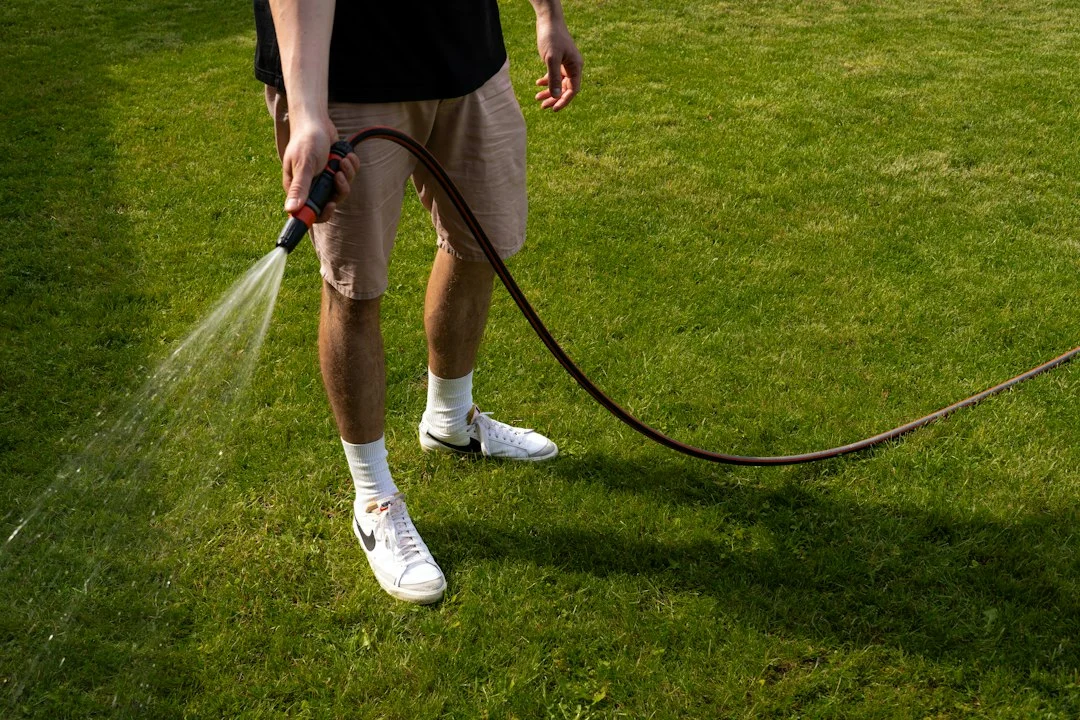
After sowing, water gently enough that seed stays in place. Keep the seed zone consistently moist through germination with light applications as weather requires; do not turn the area into mud. University of Minnesota Extension describes light, frequent watering, sometimes several times a day under drying conditions, then gradually reducing frequency as roots develop. Rain counts, and a shaded patch may dry much more slowly than a sunny curb strip.
Check the actual soil surface rather than setting a fixed sprinkler schedule and forgetting it. If it dries out repeatedly, seedlings may fail; if it is puddled, stop and let water drain. Once grass is growing and roots are extending, shift toward less frequent, deeper irrigation appropriate for established turf. University of Maryland Extension specifically distinguishes watering new seed from watering an established lawn.
Continue mowing the existing grass when necessary so it does not shade the seedlings, but avoid sharp turns over soft ground or mowing when soil is wet. As the new turf develops, return gradually to the normal mowing height for its species. Use a sharp blade and remove no more than one-third of the grass blade in a mowing, a principle Maryland Extension recommends for healthy turf.
If the seed does not take, diagnose before buying more
- Nothing emerges: confirm the seed was in contact with soil, check whether it dried out or was washed away, and review any pre-emergent herbicide used. Do not assume all grasses germinate on the same timetable. Minnesota Extension notes Kentucky bluegrass can take two to three weeks.
- Growth appears only along aeration holes: much of the broadcast seed may have landed on thatch or leaves instead of soil. Improve surface preparation before another attempt.
- Seedlings emerge then disappear: look for puddling, drying, traffic, mowing damage, or a sudden change in care. An occasional weed is not a reason to blanket tender new turf with herbicide. Check its label and local Extension guidance first.
- The same area thins again next season: reconsider shade, soil compaction, drainage, turf choice, and how the area is used. Another bag of seed alone will not change those conditions.
Questions worth answering before you start
Can I just throw seed over the existing grass?
You can scatter it, but much will sit on leaves, thatch, or clippings instead of contacting soil. Mowing temporarily shorter and roughening the surface makes the job more likely to pay off.
Should I aerate every lawn before overseeding?
No. Core aeration is most useful where compaction is a problem or where a larger area needs more soil exposure. A small, lightly thinned area may only need mowing and careful raking. Avoid working waterlogged ground.
Is fall overseeding the right fix for a brown bermudagrass lawn?
Not for permanent turf repair simply because it has entered winter dormancy. Bermudagrass is warm-season turf. Some owners temporarily overseed dormant bermudagrass with ryegrass for winter color, but that is a separate decision with spring transition costs. For damaged permanent warm-season turf, look to its active growing season.
What if I missed the local fall window?
Resist a rushed application simply to use the bag. Ask your county Extension office about the next suitable seeding period for your turf and region, and spend the waiting time fixing drainage, traffic, or shade. A well-prepared patch at the right time beats repeated seed on an unchanged site.
The short version: identify the grass, fix the reason it thinned, seed during your local cool-season establishment window, and get seed onto soil rather than foliage. Then watch the surface moisture and adjust as the seedlings grow. The result depends less on a special product than on those ordinary decisions made in the right order.
Image credit: Anastasiya Badun / Unsplash. The photograph illustrates lawn watering, an aftercare step; it does not show seed application.