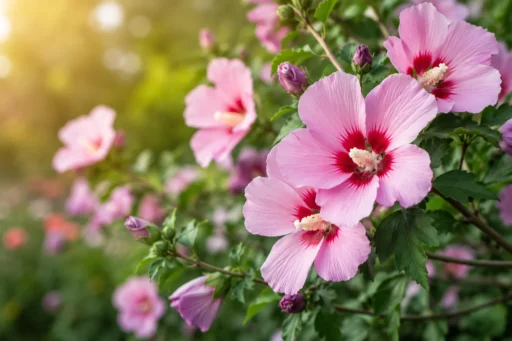
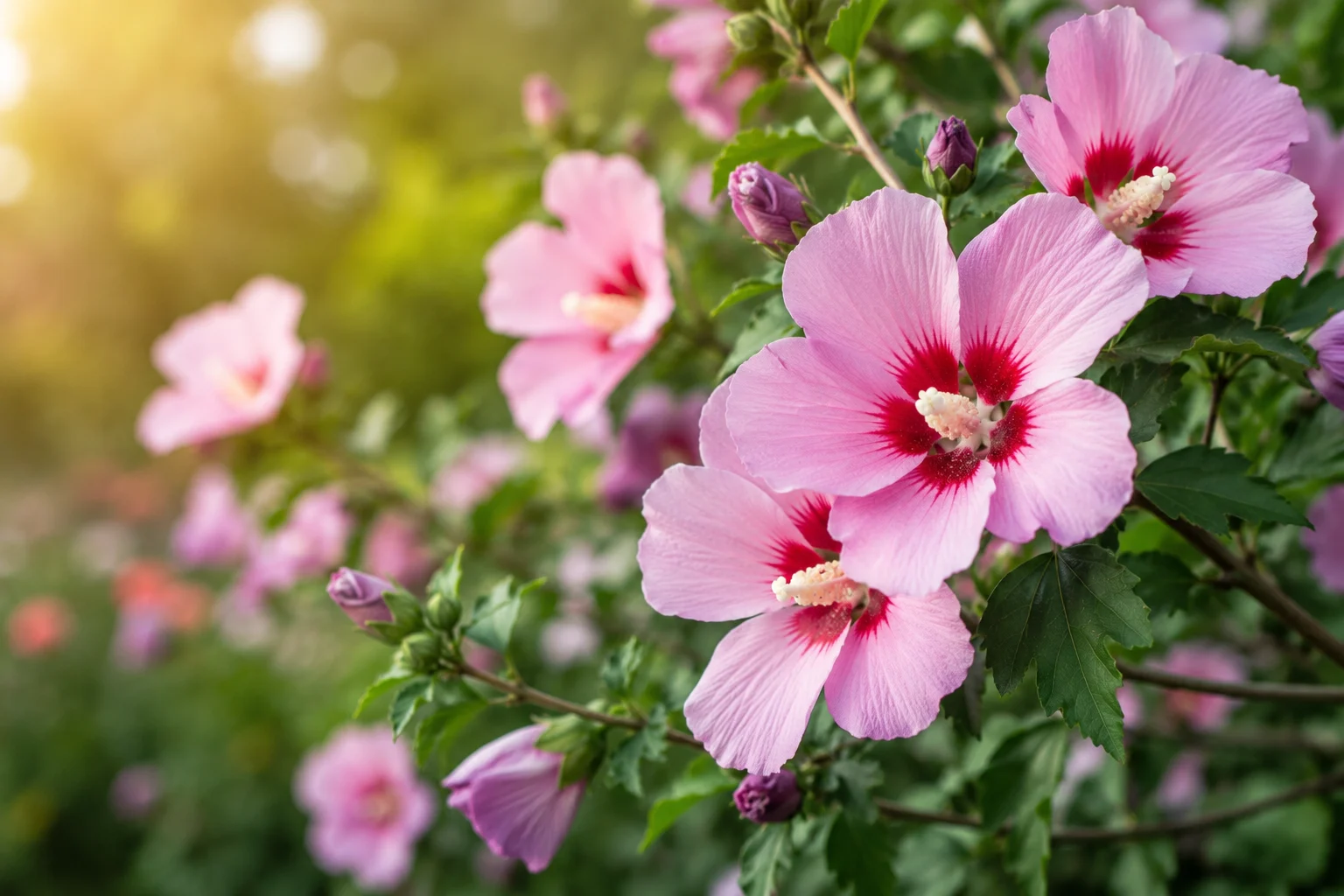
If your late-summer landscape could use a bit more color, Rose of Sharon is hard to beat. This resilient deciduous shrub, Hibiscus syriacus, native to Eastern Asia, produces exotic-looking blooms from midsummer right up until the first frost. It’s a genuinely reliable addition to any yard, and below we’ve laid out everything you need to grow it well.
Rose of Sharon belongs to the mallow family (Malvaceae) and has earned its popularity as a heat-tolerant, low-fuss flowering shrub. Here’s a quick reference for the essentials.
Shrub Profile at a Glance
- Botanical Name: Hibiscus syriacus
- Common Names: Rose of Sharon, Shrub Althea, Hardy Hibiscus
- USDA Hardiness Zones: 5 to 9 (results can vary slightly in extreme microclimates or unusually windy winter sites)
- Mature Size: 8 to 12 feet tall, 6 to 10 feet wide (compact cultivars stay much smaller)
- Sun Exposure: Full sun to partial shade, at least 6 hours of direct sun
- Soil Requirements: Rich, moist, well-draining soil; tolerates clay, loam, and sand
- Soil pH: Slightly acidic to neutral (5.5 to 7.5)
- Bloom Time: July through October, or until the first hard frost
- Flower Colors: Lavender, purple, blue, pink, red, and white, often with a contrasting dark red throat
- Toxicity: Non-toxic to dogs, cats, and horses according to the ASPCA, though eating any plant material can cause mild stomach irritation in pets
Where Is the Best Place to Plant a Rose of Sharon?
Choose a spot with full sun, well-draining soil, and some protection from harsh, drying winter winds. Aim for at least 6 hours of direct sunlight daily to get the best flowering and shape from this shrub. Partial shade is tolerable, but anything deeper tends to cause legginess, fewer flowers, and a higher risk of powdery mildew.
Drainage matters just as much as light. Before planting, dig a hole about 12 inches deep and fill it with water. If it drains within four hours, your soil drains well. If water is still sitting there after 12 hours, you’re dealing with dense, waterlogged clay that will likely cause root rot. In that case, a raised bed or a French drain is worth considering.
Young shrubs also need some wind protection in their first few years, since their stems are still fairly weak. Planting behind a fence, building, or other solid windbreak helps prevent stem splitting during heavy summer gusts or snow buildup.
Growing Requirements and Environmental Needs
Caring for Rose of Sharon becomes much simpler once you understand how it grows in its native range across eastern Asia. Unlike its more tender tropical hibiscus relatives, this is a true deciduous shrub, and a remarkably forgiving one at that, handling tough urban conditions, average soil, and heavy humidity without much fuss.
Sunlight and Airflow
Full sun is ideal, though afternoon shade can help in the hotter parts of Zone 8 and Zone 9, where intense afternoon sun can bake tender petals. Good airflow around the shrub also helps prevent fungal issues, so space plants at least six to ten feet apart.
Temperature and Humidity
This shrub is impressively cold hardy, tolerating temperatures down to -20°F once dormant and fully hardened off. It’s also a genuine heat lover and handles high humidity well, provided there’s enough air circulation around it.
Solera Gardens Tip: The Spring Wake-Up Illusion
Don’t panic if your shrub looks like a bundle of bare twigs in early spring. Rose of Sharon is a notoriously late riser, often not leafing out until late May or even early June in cooler Zone 5 gardens. Plenty of gardeners have mistakenly dug up a perfectly healthy shrub in April, assuming it died over winter. Before you do the same, try a scratch test: gently scrape a small patch of bark with your fingernail. Bright green underneath means the shrub is alive and simply waiting for warmer weather.
Step-by-Step Planting Instructions
Timing plays a big role in how well a new shrub establishes. Both spring and fall planting are workable, but in cooler zones like 5 and 6, spring planting is generally the safer choice, giving roots a full growing season to settle in before facing winter’s freeze and thaw cycles.
Follow these steps for a smooth transition from nursery pot to garden bed:
- Prepare the hole. Measure the height and width of the nursery container, then dig a hole the same depth as the root ball but roughly twice as wide.
- Locate the root flare. Gently remove loose soil from the top of the pot until you can see the root flare, the point where the trunk widens to meet the root system.
- Place the plant. Set the shrub in the center of the hole so the root flare sits level with, or slightly above, the surrounding soil. Planting too deep is one of the most common causes of decline and root crown rot.
- Backfill the hole. Use only the native soil you removed. Avoid mixing in large amounts of compost, peat, or fertilizer directly into the hole, since this can create a “bathtub effect” that traps water. If your soil is especially heavy clay, amending the entire planting area, rather than just the hole, works better.
- Water deeply. Give the plant 5 to 10 gallons of water slowly to settle the soil and eliminate any trapped air pockets.
- Apply mulch. Spread 2 to 3 inches of organic mulch, like shredded hardwood or pine bark, around the root zone, keeping it about 3 inches from the trunk to avoid trapping moisture or attracting rodents.
Watering and Fertilizing Schedules
Getting the balance of moisture and nutrients right makes a real difference in bloom quality.
Precise Watering Rules
Mature, established shrubs are surprisingly drought tolerant, but young plants need consistent watering through their first two growing seasons. Check by pushing a finger about two inches into the soil. If it comes out dry, water the plant. If it’s cool and moist, wait a couple more days.
During the first summer, aim for a couple of deep soakings a week rather than a light daily sprinkle. Deep watering encourages roots to grow down into cooler, more moisture-retentive soil, which makes the plant far more drought resilient later on.
Nutritional Guidelines
This shrub rarely needs heavy feeding. Overfeeding is actually the more common problem, leading to lanky growth with fewer flowers than you’d expect. In most cases, a thin annual layer of compost, about an inch deep, is all the nutrition it needs.
If you do want to feed it, work a slow-release balanced granular fertilizer (something like 10-10-10) into the soil in early April, at half the rate listed on the package. Avoid high-nitrogen feeds, since they push leafy growth at the expense of flowers and tend to attract sap-sucking pests. Skip any additional feeding until the following spring, since late-season growth is more vulnerable to an early frost.
Selecting the Perfect Cultivar: Top Rose of Sharon Varieties
The right variety depends on how much space you have and the effect you’re going for. Older, wild varieties reseed prolifically and can feel like a constant weeding chore, while modern hybrids are usually sterile or produce very few viable seeds.
| Shrub Variety | Unique Key Feature | Mature Height & Spread | Landscape Use |
| ‘Aphrodite’ | Sterile, deep pink blooms with red eyes | 9 ft tall x 7 ft wide | Specimen plant, cottage gardens |
| ‘Blue Chiffon’ | Semi-double lavender-blue, high nectar | 10 ft tall x 6 ft wide | Wildlife garden, mixed shrub border |
| ‘Lil’ Kim’ | Compact dwarf, white flowers with red eyes | 3 ft tall x 3 ft wide | Containers, small entryways, low borders |
| ‘Purple Pillar’ | Narrow, columnar growth habit | 14 ft tall x 4 ft wide | Privacy screen, narrow side yards |
| ‘Sugar Tip’ | Variegated foliage, sterile pink double blooms | 6 ft tall x 5 ft wide | Accent plant, year-round leaf interest |
Why We Selected These Varieties
- Best for beginners (‘Aphrodite’): A tough, well-loved variety that grows to an impressive size. Since it’s sterile, you won’t be pulling seedlings every spring.
- Best for pollinators (‘Blue Chiffon’): Its powdery-textured, nectar-rich center and easily accessible stamens make it a favorite with bees and hummingbirds alike.
- Best for containers (‘Lil’ Kim’): A genuine dwarf that stays compact, unlike standard varieties that quickly outgrow a pot.
- Best for small gardens (‘Purple Pillar’): Its narrow, columnar form delivers height without eating up horizontal space in a tight yard.
- Best for low-maintenance landscapes (‘Sugar Tip’): The variegated green and white foliage looks great even when it’s not in bloom, and being sterile means no weeding.
Rose of Sharon Pruning and Maintenance
Before reaching for the pruners, it helps to understand how this shrub grows. Rose of Sharon blooms on new wood, meaning the fresh green stems that emerge each spring and summer. The best time to prune is late winter or very early spring, typically February or March depending on your climate, before those new shoots start pushing through. Pruning later in spring or early summer risks cutting off flowers before they even have a chance to open.
Three Strategic Pruning Methods
| Pruning Goal | When to Use | Recommended Technique | Expected Result |
| Rejuvenation Pruning | Old, overgrown, or neglected shrubs, during late winter dormancy | Remove one-third of the oldest stems at the soil line each year, over three years | Encourages vigorous new growth and restores a fuller shape |
| Size Control Pruning | Shrubs that have outgrown their space | Reduce the canopy by up to 30%, cutting just above outward-facing buds | Maintains a manageable size and improves airflow |
| Maximum Flowering Pruning | Flowering shrubs blooming on new growth | Thin crowded interior branches and tip-prune lateral stems by 4 to 6 inches (10 to 15 cm) | Increases light and air circulation for stronger, more abundant blooms |
Always perform these methods in late winter or early spring before new growth begins, using clean, sharp tools, and avoid removing more than a third of the shrub in a single season unless you’re doing gradual rejuvenation pruning over multiple years.
Rejuvenation pruning works well on an overgrown, woody shrub. Each late winter, cut about a third of the oldest, greyest stems down to ground level. New shoots will emerge from the base, gradually renewing the whole plant without shocking it.
Size control comes down to trimming each branch by roughly a third, cutting at a 45-degree angle about a quarter inch above an outward-facing bud. This encourages the plant to branch outward rather than crowding its center.
Flower maximization means thinning out some interior branches to let in more light and air, then shortening the remaining side branches by 4 to 6 inches to encourage more side blooms.
Deadheading to Prevent Seedlings
If your shrub is an older, fertile variety, deadheading spent blooms can meaningfully cut down on unwanted seedlings. It’s tedious work on a large shrub, but skipping it means dealing with thousands of seedlings sprouting across your beds and lawn the following spring.
Companion Plants and Ecological Benefits
Working Rose of Sharon into a layered garden design boosts both its visual appeal and its value to local wildlife.
Companion Planting Ideas
Because this shrub grows in a neat, upright vase shape, there’s usually open ground beneath it well suited to low-growing, full-sun companions.
- Coneflower (Echinacea): Its simple daisy shape contrasts nicely with the ruffled hibiscus blooms.
- Russian sage (Salvia yangii): Airy, lavender-blue spikes provide a fine-textured backdrop to the bolder hibiscus flowers.
- Ornamental grasses, like fountain grass (Pennisetum): Add movement and soft texture against the shrub’s stiffer, woody branches.
- Lavender: A fragrant, silvery ground cover that thrives in the same sunny, well-draining conditions near the shrub’s drip line.
Wildlife and Pollinator Benefits
These large, nectar-rich flowers are especially valuable in late summer, when many other native nectar sources have finished blooming. Bumblebees, long-tongued bees, and hummingbirds are frequent visitors around the prominent central stamen column.
If attracting luna moths to your garden is also on your list, planting host species like sweetgum or hickory nearby, alongside these nectar-rich summer bloomers, gives you both caterpillar habitat and adult moth food in one spot.
Troubleshooting Common Problems
Even a low-maintenance plant runs into the occasional issue. Learning to read the leaves helps you catch problems early.
Yellowing Leaves
This is usually a sign of overwatering or poor drainage. Waterlogged soil deprives roots of oxygen, which can lead to root rot and eventual collapse of the plant’s structure. Cut back on watering, make sure mulch isn’t piled against the stem, and let the top three inches of soil dry out completely before watering again. If the problem continues, consider relocating the shrub to a spot with better drainage.
Bud Drop (Flowers Falling Off Before Opening)
Bud drop is a classic stress response, usually tied to one of three causes:
- Extreme drought: The plant sheds buds to conserve water during very dry, hot spells.
- Temperature swings: A sharp cold snap or an intense heat wave can both trigger premature bud drop.
- Over-fertilization: Too much nitrogen encourages leafy growth at the expense of buds.
Keeping a consistent layer of mulch, watering deeply during heat waves, and skipping fertilizer after midsummer all help minimize this issue.
Pests and Diseases
- Japanese beetles: These metallic green pests skeletonize leaves and flowers. Handpicking them in the cooler morning hours, when they’re slow moving, and dropping them into soapy water is usually the most effective control.
- Aphids: Small green or black insects that cluster on new growth. A strong blast from the garden hose knocks most of them off, with organic insecticidal soap as a backup for larger infestations.
- Powdery mildew: This fungal disease coats leaves in a dusty white film. Prevent it by spacing plants properly, pruning to improve airflow, and watering at the base of the plant rather than over the foliage.
Container Gardening and Seasonal Maintenance
Growing this shrub in a container works well for patios, balconies, or small urban gardens.
Potting and Soil Mix
Skip standard garden soil in containers, since it’s too heavy and compacts easily, suffocating the roots. Instead, use a custom mix of:
- 60% high-quality peat or coir-based potting mix
- 30% perlite or coarse pumice for drainage
- 10% organic compost for slow-release nutrients
Check soil moisture daily during peak summer. Container plants dry out faster than those in the ground and typically need a deep watering every two to three days.
Overwintering Container Specimens
Overwintering a container-grown shrub takes a different approach than an in-ground plant, since roots confined to a pot are far more exposed to freezing temperatures from all sides.
Once the leaves drop naturally in late autumn, move the container to a more sheltered spot, such as near a south-facing wall, inside an unheated garage, or wrapped in several layers of burlap. Water sparingly once in December or January, as long as the soil is dry and the ground isn’t frozen solid, just enough to keep the roots from drying out entirely.
Frequently Asked Questions
Is Rose of Sharon invasive?
Some older varieties can spread aggressively in certain regions thanks to heavy, viable seed production. Choosing newer sterile hybrids, like the Chiffon or Satin series, or consistently deadheading spent blooms, keeps this in check.
Why is my Rose of Sharon not leafing out in spring?
This shrub is known for waking up late, often not showing new growth until mid to late May. Try a scratch test on a branch. Green underneath the bark means the plant is alive and simply waiting for warmer weather.
Why are my Rose of Sharon buds falling off before they open?
This is usually tied to environmental stress, whether that’s inconsistent watering, waterlogged soil, or a sudden temperature swing. Keeping at least 2 inches of mulch down and maintaining even soil moisture during bloom season helps prevent it.
Can you grow Rose of Sharon from cuttings?
Yes, softwood cuttings taken in late spring or early summer root fairly easily. Dip a 4 to 6 inch cutting in rooting hormone, place it in a moist, well-draining mix, and keep it in a shaded, humid spot until roots develop.
Why are the leaves on my Rose of Sharon turning yellow?
This is typically a sign of overwatering or poor drainage limiting oxygen to the roots. Cut back on watering and confirm the plant isn’t sitting in standing water.
Is Rose of Sharon toxic to dogs or cats?
No. The ASPCA lists Hibiscus syriacus as non-toxic to dogs, cats, and horses, though it’s still worth discouraging pets from chewing on the leaves, since woody plant material can cause mild stomach upset.
Does Rose of Sharon bloom on old wood or new wood?
It blooms exclusively on new wood, meaning the current season’s growth. Prune in late winter or early spring while the plant is dormant to avoid accidentally removing next year’s flowers.
Conclusion
Between its heat tolerance, striking tropical-looking blooms, and generally low-maintenance nature, Rose of Sharon remains one of the best choices for a late-summer garden. Pick the right cultivar for your space, follow the care guidelines above by Solera Gardens, and you’ll be enjoying this shrub’s colorful display for many years to come.
Plan access and planting space with our beginner garden planning guide.
When covering soil around plants, consult our garden mulching guide for materials and application advice.