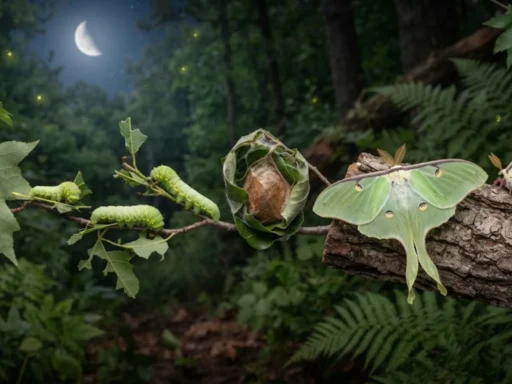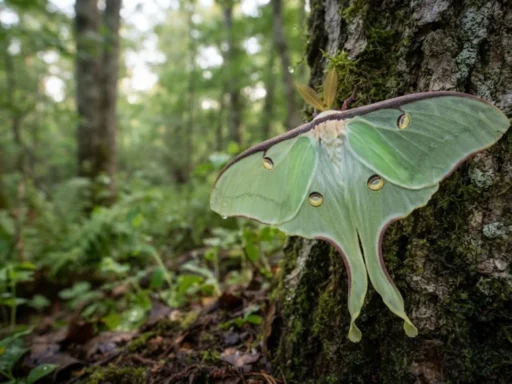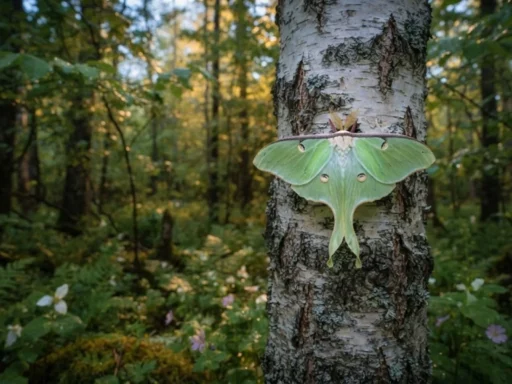

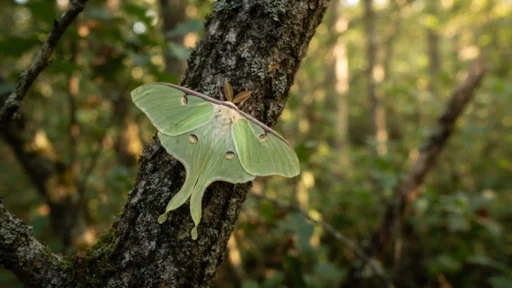
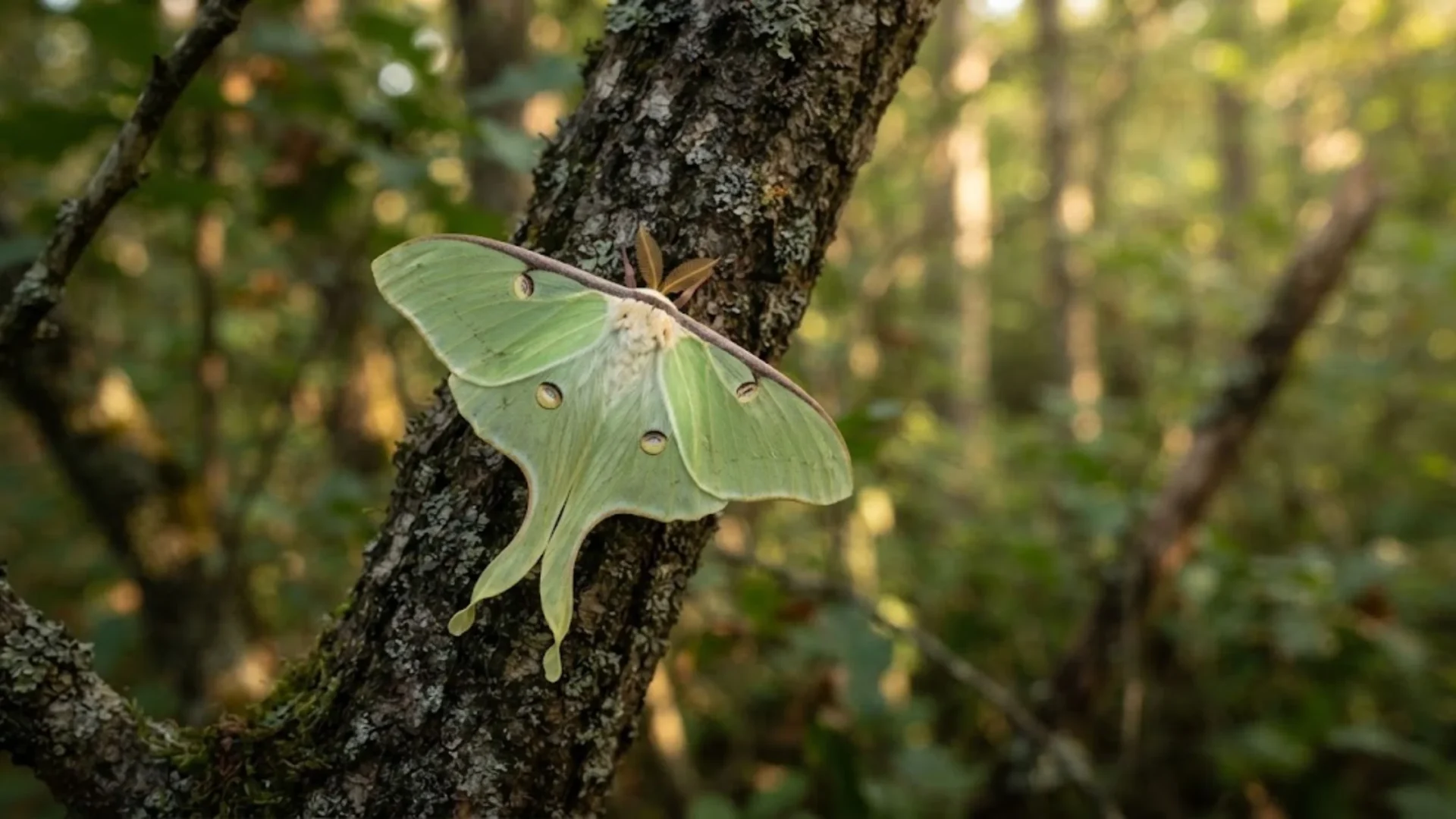
A luna moth (Actias luna) is a large, pale green moth with two long, curving tails on its hindwings and a small eyespot on each of its four wings. Its wingspan is roughly 3 to 4½ inches, its body is fuzzy and white, and the front edge of each forewing has a pinkish-purple to yellowish stripe. If you’re looking at a big lime-green moth with long tails in eastern North America, you’re almost certainly looking at a luna moth.
This Solera Garden guide shows you how to confirm that ID in a few seconds, how the moth’s appearance changes with the season and between males and females, and how to recognize the caterpillar and cocoon you might find in your yard.
Quick Luna Moth Identification: The 5-Point Check
Run through these five features. If your moth matches all five, you can be confident in your Luna Moth identification.
- Color: Pale green to lime or yellow-green wings. No other common North American moth this size is green.
- Tails: Each hindwing ends in a long, slender tail that often curls or twists slightly.
- Eyespots: One small, round eyespot sits near the center of each of the four wings. The spots have a clear “window” in the middle.
- Forewing edge: The leading edge of each forewing has a darker band, usually pinkish-purple or reddish-brown in spring moths and more yellowish in summer moths.
- Size: A wingspan of about 3 to 4½ inches (roughly 7.5 to 11 cm), about as wide as your palm.
If one feature doesn’t fit, especially the green color or the tails, check the look-alike section below.
Luna Moth Appearance in Detail
Wings
The wings are the clearest part of Luna Moth appearance. They range from soft sea-foam green to bright lime, and the color fades toward yellow as the moth ages. The hindwing tails can be nearly as long as the rest of the wing. In older moths you’ll often see tails that are frayed, bent, or missing, so a short-tailed green moth can still be a luna.
The eyespots are more subtle than on many other silk moths. Each one is a small oval ringed with yellow, black, and a reddish or bluish edge, with a translucent center you can sometimes see light through.
Body and legs
The body is thick, covered in dense white hair, and looks almost furry. The legs are pinkish to purplish. Together with the green wings, this white body is a quick tell when the moth’s wings are partly closed.
Antennae
Luna moths have broad, feathery antennae shaped like small ferns. These help adult males detect the scent females release when they’re ready to mate.
No mouth
Adult luna moths don’t have functional mouthparts and don’t eat. They live on fat stored as caterpillars and survive only about a week, long enough to mate and lay eggs. So if you find one resting all day without moving, that’s normal behavior, not a sign it’s sick.
How to Tell Male and Female Luna Moths Apart
Look at the antennae first. They’re the most reliable clue.
| Feature | Male | Female |
|---|---|---|
| Antennae | Wider and very feathery | Narrower, thinner “feathers” |
| Abdomen | Slimmer | Plumper, especially before laying eggs |
| Color | Varies; often reported as slightly more yellow-green | Varies; often reported as slightly more blue-green |
Wing color between sexes is a weak clue, because season and age shift color more than sex does. Use antennae and body shape instead.
Why Luna Moths Look Different in Spring and Summer
You might see two luna moths that don’t quite match. That’s because luna moths have one to three generations (broods) a year depending on where you live.
- Spring brood: Usually a deeper green with pink to reddish-purple wing margins.
- Later summer broods: Usually paler and more yellowish, with yellow margins instead of purple.
In northern areas there’s typically one generation, flying from about May to July. Farther south, two or three generations can fly from March to September. If you see a yellowish luna in August, it’s simply a later brood.
Where and When You’re Likely to See One
Luna moths live across eastern North America, from southern Canada (Nova Scotia west to Saskatchewan) south to central Florida, the Gulf Coast, and eastern Texas. They’re tied to areas with hardwood trees, since the caterpillars feed on species such as white birch, sweetgum, hickory, walnut, persimmon, and sumac.
Because they’re nocturnal and drawn to light, you’ll most often spot one in the morning, resting on a wall, door, or screen near a porch light. During the day you may find one hanging from a twig or trunk, where its green wings blend in with leaves.
Actias luna Identification by Life Stage
Full Actias luna identification includes more than the adult. Here’s what each stage looks like:
| Life stage | What it looks like | Where you’ll find it |
|---|---|---|
| Egg | Tiny (under 2 mm), slightly oval, white mottled with brown | Laid in small groups on leaves of host trees |
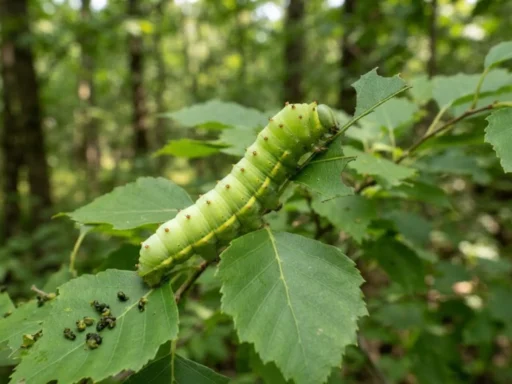
| Caterpillar | Bright green, up to about 2¾ inches long, with a pale yellowish line along each side low on the body, faint yellow lines across the back, and small reddish-orange to pink bumps with short hairs | Feeding alone on hardwood leaves; often high in the tree |
| Cocoon | Thin, papery, brown silk wrapped in dead leaves; looks like a crumpled leaf bundle | On the ground in leaf litter under host trees, especially in fall and winter |
| Adult | Pale green with long tails, eyespots, and a white body | Near lights at night; resting on walls or trees during the day |
How to recognize the caterpillar
A luna moth caterpillar is plump, smooth-looking, and the same bright green as fresh leaves. When disturbed, it may rear up and make a clicking sound with its jaws. It can also spit up a bad-tasting fluid as a warning. It’s harmless to you, so just leave it on its tree.
How to recognize the cocoon
The cocoon is the stage you’re most likely to miss. It’s not hung from a twig like many silk moth cocoons. Instead, it’s wrapped in leaves and falls to the ground with them in autumn. That means a pile of fallen birch or hickory leaves can hold overwintering luna pupae. If you want to protect them, leave some leaf litter in place during fall garden cleanup instead of bagging every leaf under your hardwoods.
Luna Moth Look-Alikes and How to Rule Them Out
| Look-alike | How it differs from a luna moth |
|---|---|
| Polyphemus moth (Antheraea polyphemus) | Tan to brown, not green, with a large eyespot on each hindwing and no long tails |
| Polyphemus caterpillar | Also big and green, but its yellowish side lines run at a slant rather than as one continuous line along the body |
| Emerald moths (small green geometrid moths) | Green, but only around an inch across and without tails |
| Asian moon moths (other Actias species, such as the Indian moon moth) | Similar shape, but often with much longer tails; not native to North America and usually seen only in butterfly houses or with breeders |
| Io, imperial, and cecropia moths | Related giant silk moths, but yellow, yellow-and-purple, or reddish-brown, not green, and without long tails |
If you’re in eastern North America and the moth is green with long tails, the luna moth is by far the most likely match. Side-by-side comparisons like this are the fastest way to identify any garden insect, the same approach we use in our guide to telling a hornet from a wasp.
Why Luna Moths Look the Way They Do
Each part of the luna moth’s look helps it survive:
- Green wings blend in with leaves, hiding the moth during the day.
- Eyespots may startle or confuse predators.
- Long, twisting tails spin as the moth flies. Research suggests this disrupts bat echolocation, so bats attack the expendable tails instead of the body. That’s one reason you’ll often see adults with damaged tails.
What to Do If You Find a Luna Moth
- Look, don’t handle. The scales on the wings rub off easily, and touching can harm the moth.
- Take a photo from the top and side so you can check the tails, eyespots, and antennae.
- Leave it where it is. It’s probably resting before nightfall and doesn’t need food or water.
- Dim your outdoor lights. Bright lights pull moths off course during their short mating window.
If spotting one makes you want more, you can turn your yard into luna moth habitat with the right host trees and lighting. A night-blooming plant like moonflower also makes your yard more inviting to other large night-flying moths, even though adult lunas don’t feed.
Conclusion
To identify a luna moth, check for pale green wings, two long hindwing tails, four small eyespots, a white fuzzy body, and a 3- to 4½-inch wingspan. Use the antennae to tell males from females, and remember that spring moths look greener with purple edges, while summer moths look more yellow.
Your next step: this fall, before you rake under birch, hickory, sweetgum, or walnut trees, look for papery leaf-wrapped cocoons and set aside a corner of leaves to stay undisturbed until spring. If you’d rather compost the rest, our guide to composting leaves shows how to handle them without clearing every bed.
FAQ
Are luna moths rare?
No. Luna moths are common across much of eastern North America. You just don’t see them often because they fly at night and live only about a week as adults.
Are luna moths poisonous or dangerous?
No. Adult luna moths can’t bite or sting, and the caterpillars aren’t venomous. The caterpillar’s clicking and regurgitation are only defensive displays.
Do luna moths come in colors other than green?
Their green ranges from bluish-green to yellow-green depending on the season, brood, and age. A tailed moth that’s brown or gray is a different species.
What month do you usually see luna moths?
In northern areas, mostly late May through July. In the South, you can see them from March through September across multiple broods.