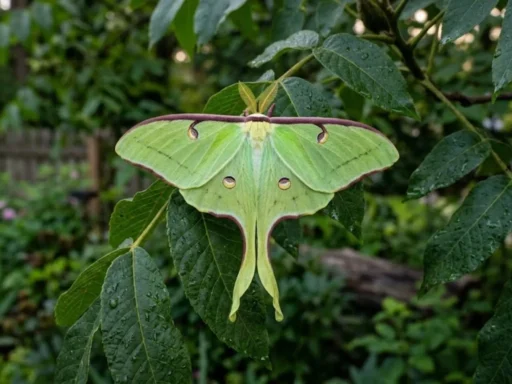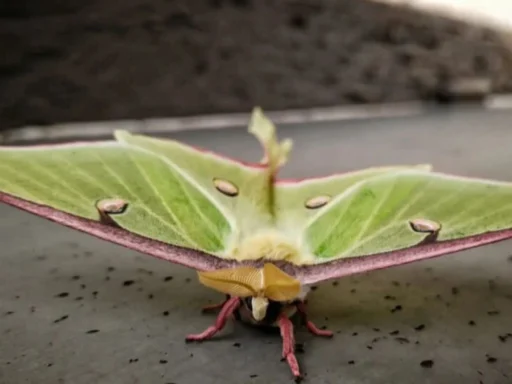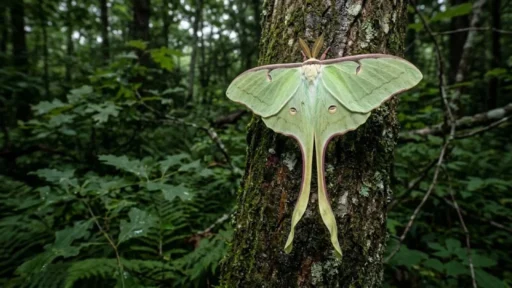
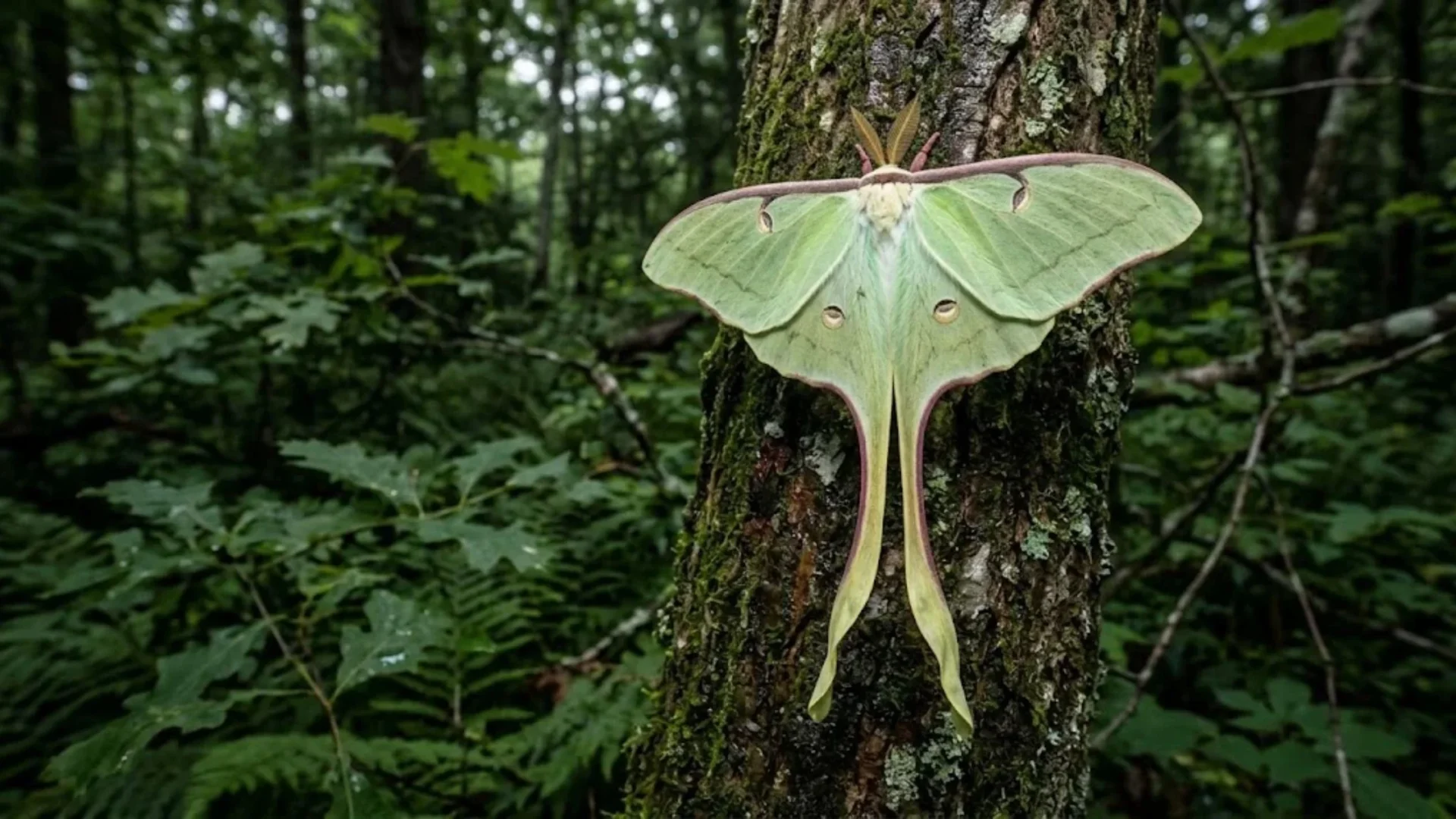
Luna moths have long tails because those tails work as a decoy against bats. As the moth flies, the twisting tails bounce back sonar echoes that pull a hunting bat’s attack away from the moth’s body and toward a part it can afford to lose. Here at Solera Garden, we’ve covered how to identify, raise, and attract these pale-green giants, and in this guide you’ll learn exactly how the Luna moth tail function works, what researchers have measured, what the wing markings add, and what it means when you find a Luna moth with torn or missing tails.
The Short Answer: Tails Are an Anti-Bat Decoy
The Luna moth (Actias luna) is a giant silk moth in the family Saturniidae, active at night across much of eastern North America. Its main nighttime predators are insect-eating bats, which find prey by echolocation: they shout high-pitched calls and listen to the echoes.
Each Luna moth hindwing ends in a long, slender tail. In flight, those tails spin and flutter behind the moth. To a bat “seeing” with sound, the moving tails create a strong, confusing echo target separate from the body. Bats often strike the tails instead of the abdomen and thorax, and the moth flies away with a damaged wing edge rather than becoming a meal.
That’s the core purpose of the tails: misdirection, not flight performance or display.
Why a Luna Moth Needs This Defense in the First Place
The tails make more sense once you see what a Luna moth can’t do.
- It can’t hear bats coming. Many night-flying moths have ears tuned to bat calls and dive or zigzag when they hear one approach. Giant silk moths like the Luna moth lack these ears, so they get no early warning.
- It can’t refuel. Adult Luna moths have vestigial mouthparts and do not eat. As we explain in our guide to how long Luna moths live, an adult usually survives only about 7 to 10 days on energy stored as a caterpillar.
- It must fly at night to reproduce. Males fly searching for females’ scent, and females fly to lay eggs. Every flight crosses bat hunting territory.
A short-lived, deaf, non-feeding moth can’t rely on hiding or fleeing. It needs a defense that works after the bat has already locked on. The tails do exactly that.
How the Tails Fool a Bat’s Sonar
The tail trick is called acoustic deflection. It works much like a lizard’s detachable tail or a butterfly’s eyespot, except it targets hearing rather than sight.
- The bat locks on. It sends rapid ultrasonic calls and builds a picture of the moth from the returning echoes.
- The tails spin. The long, twisted hindwing tails rotate and flutter as the moth beats its wings, sending back echoes from behind the body.
- The bat aims at the wrong echo. The tail echoes appear to be an attractive target, so the bat often aims for the trailing tails.
- The moth escapes with damage. The bat grabs or clips wing material at the tail end, which isn’t vital, and the moth keeps flying.
Researchers also found that bats didn’t seem to learn their way around the trick. In the 2018 follow-up study described below, bats didn’t get better at telling body from decoy even after months of exposure to the same wing shapes.
What the Research Found
Luna moth defense has been tested directly. Two studies led by researchers from Boise State University and the Florida Museum of Natural History, University of Florida, are the best-known.
The 2015 Luna moth experiment
Biologists Jesse Barber and Akito Kawahara flew Luna moths against big brown bats in a flight room and recorded each encounter with high-speed infrared cameras and ultrasonic microphones. The results, published in the Proceedings of the National Academy of Sciences, showed that:
- Bats aimed at the tails in 55% of interactions.
- Moths with tails had a 47% survival advantage over moths without tails.
- That benefit is roughly the same advantage other moths get from having bat-detecting ears.
The 2018 silk moth comparison
A later study in Science Advances compared Luna moths, polyphemus moths, and African moon moths and found that “the larger the hindwings and longer the tails, the better the moths’ chances of escaping.” For African moon moths:
| Tail condition | Escape rate from bats |
|---|---|
| Full natural tails | 73% |
| Shortened tails | 45% |
| Tails removed | 34% |
The researchers also found that tail-like hindwing shapes evolved repeatedly across silk moths worldwide, with unrelated species arriving at nearly identical shapes. The 2015 work reported that long hindwing tails evolved independently four times within the family. When one solution shows up again and again in different moths, that’s strong evidence it does an important job.
What this means for you: the tail-as-decoy explanation isn’t a guess. It’s one of the better-tested anti-predator defenses in North American insects.
Do Luna Moth Wing Markings Help Too?
Luna moth wing markings add to the defense, but they’re less proven than the tails, so it helps to separate what’s measured from what’s likely.
| Feature | What it looks like | Most likely role | How well supported |
|---|---|---|---|
| Hindwing tails | Long, slender, often curled | Redirect bat attacks by echo | Directly tested in experiments |
| Pale green color | Sea-foam to lime green | Blends with leaves when resting by day | Widely accepted camouflage explanation |
| Eyespots | One small ringed spot on each wing | Possible distraction or startle against visual predators such as birds | Plausible, less specifically tested in Luna moths |
| Darker forewing edge | Purplish to reddish-brown band | Breaks up the outline at rest | Plausible camouflage aid |
The important point: bats hunt by sound in the dark, so eyespots and color mostly matter during the day, when a resting Luna moth hangs among leaves and visual predators are the threat. The tails cover the night shift. If you want a full field guide to these features, see our article on what a Luna moth looks like and how to identify one.
What Missing or Torn Tails Tell You
If you find a Luna moth with one tail, ragged tails, or no tails at all, the moth may have survived a bat attack. The tails are built to be lost. Damage doesn’t automatically mean the moth is sick or dying.
Use these clues to read what you’re seeing:
- One tail missing, wings otherwise intact: a classic sign of a successful decoy. The bat got the tail, not the moth.
- Both tails frayed and wing edges worn: often just an older adult near the end of its roughly one-week life.
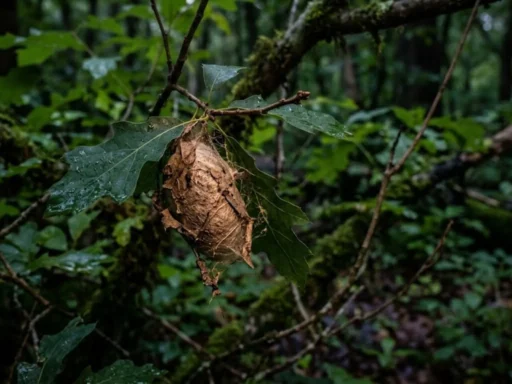
- Crumpled, unexpanded wings with no tears: this points to a problem during emergence, not predation. Our guide to the Luna moth life cycle from egg to adult explains what happens when an adult first leaves the cocoon.
Either way, the best thing you can do is look, photograph, and leave it alone. Handling can rub scales off the wings and waste energy the moth can’t replace.
How Your Yard Can Support Luna Moths
You can’t give a Luna moth better tails, but you can reduce the extra risks it faces on top of bats.
- Dim or warm your outdoor lights. Bright white lights pull moths into the open, where they circle until exhausted and become easy targets. Amber bulbs or motion-sensor lights help.
- Skip bug zappers and broad-spectrum sprays. They kill moths and the caterpillars that feed on your trees.
- Plant or keep host trees. Caterpillars feed on trees such as birch, sweetgum, hickory, and persimmon.
- Leave some fallen leaves. Cocoons overwinter in leaf litter, so a patch of undisturbed leaves protects next year’s adults.
For a step-by-step plan, read our guide on how to attract Luna moths with host trees and the right yard setup. To know when to watch for adults with intact tails, check when Luna moths come out and what time of year they’re active.
Conclusion: A Tail Built to Be Lost
Luna moth tails are a sacrificial target. They spin in flight, create echoes that draw bat strikes away from the body, and measurably improve a moth’s odds of surviving the night. Combined with leaf-green camouflage by day, they form a two-part defense for a moth that can’t hear bats, can’t eat, and has only about a week to find a mate.
Your next step: the next time you see a Luna moth on your porch or a tree trunk, check its tails. A missing one is likely a sign it already won one round against a bat. Then turn off the porch light so it doesn’t have to fight another.
Frequently Asked Questions
Do Luna moths use their tails to fly?
No. The tails aren’t needed for flight. Moths with shortened or missing tails can still fly. They just lose part of their protection against bats.
Do Luna moth tails grow back?
No. Adult moths don’t regrow wing tissue, so a lost tail stays lost for the rest of the moth’s short adult life.
Are Luna moths the only moths with tails like this?
No. Several other giant silk moths, including the African moon moth and other moon moths, have long hindwing tails. Related moths such as the polyphemus moth use large rounded hindwing lobes for a similar effect.